Geosyntec Consultants Logo

Evan Cox

Optimizing Flow and Load Distribution Within a Sewage Treatment Distribution Chamber in England

2026-04-02T16:32:44-06:00May 8th, 2016|Tags: , , , , , , |

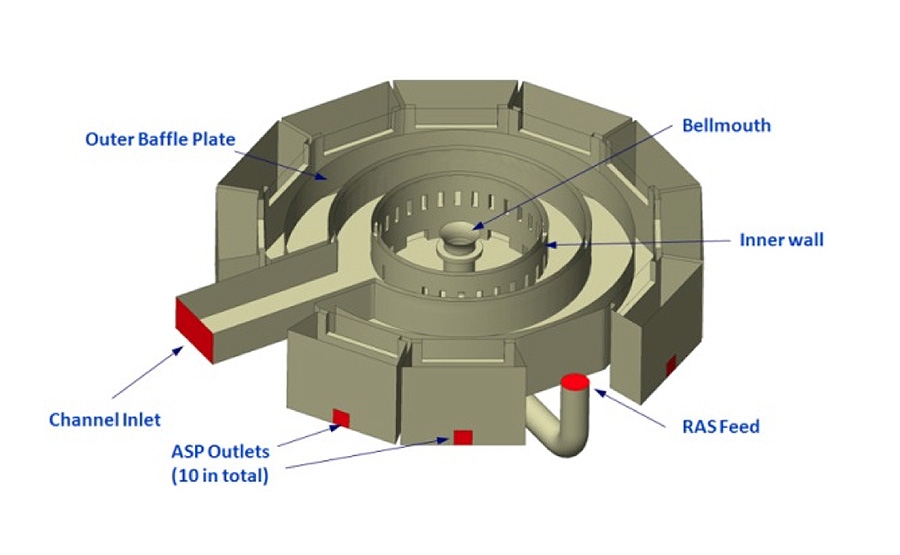
Civil engineering structures are used to distribute the flow and solid loads to multiple settling tanks or activated sludge plant (ASP) lanes at a sewage treatment works (STW). Achieving a good solids distribution requires adequate mixing to homogenise the solids, but this can be detrimental to achieving a good flow distribution, which normally requires quiescent conditions.

Analysis and Design for Final Clarifiers in England

2026-04-02T16:32:44-06:00May 8th, 2016|Tags: , , , , , , |

The Budds Farm Wastewater Treatment Works operated by Southern Water Services Ltd. treats waste water from the Portsmouth and Havant catchments. Prior to 2006, the Wastewater Treatment Works at Budds Farm had eight final clarifiers of 35m internal diameter. In order to meet the requirement of projected AMP4 flows, the existing settlement tanks were modified and two new 35m diameter clarifiers were built to operate alongside the existing eight tanks.

Vapor Intrusion Assessment Near a Residential Development in United Kingdom

2026-04-02T15:02:13-06:00February 24th, 2016|Tags: , , , , , , |

In 1993, as a result of corporate safety, health and environmental policies, the client initiated a review to assess potential hazards to human health and the environment resulting from historical industrial waste disposal activities.

Swedish National Guidance Manual on Chlorinated Solvent Remediation

2026-04-02T15:02:29-06:00February 23rd, 2016|Tags: , , , , , , |

Like other industrialized nations, groundwater supplies beneath many industrial sites in Sweden are contaminated with chlorinated solvents. Compared to countries in North America and other parts of Europe, however, chlorinated solvent impacts in Sweden have not attracted much attention until recently. In 2005, the Swedish Environmental Protection Agency (Naturvardsverket) recognized the need for national guidance on chlorinated solvent remediation. To meet this need, they commissioned a project for the development of a Technical Manual for Screening and Selecting Technologies for Remediation of Chlorinated Solvents in Soil and Groundwater and selected an international team of experts, consisting of SWECO VIAK (Sweden), Geosyntec Consultants (USA and Canada), and COWI A/S (Denmark) to write the Manual.

Biostimulation and Bioaugmentation for Passive In Situ Remediation of Chlorinated Solvents in Denmark

2026-04-02T15:12:12-06:00February 23rd, 2016|Tags: , , , , , , |

Groundwater beneath a former manufacturing facility in a small Danish town is contaminated with part-per-million levels of trichloroethene (TCE) and cis-1,2-dichloroethene (cDCE). The TCE and cDCE contamination occurs primarily in a low-permeability clay layer that is not amenable to an active forced-gradient bioremediation design.

In Situ Bioremediation of Trichloroethene and Hexavalent Chromium in Denmark

2026-04-02T15:12:09-06:00February 23rd, 2016|Tags: , , , , , , |

Trichloroethene (TCE) and hexavalent chromium (CrVI) have impacted shallow groundwater beneath an active manufacturing facility in Svendborg, Denmark. The site is primarily underlain by moraine clay deposits, and a thin sand layer is continuous across much of the site.

Development of National Guidance Manual on Bioavailability Assessment in Sweden

2026-04-02T15:12:08-06:00February 23rd, 2016|Tags: , , , , , , |

Risk assessment at contaminated sites in Sweden currently follows a methodology that includes the use of guideline values, which are not valid for a number of sites. As an alternative to the use of guideline values, the use of a detailed site-specific approach requires an understanding of the bioavailability in soil and sediment.

Feasibility Study and Treatability Testing for a Shoreline Site Impacted by Pharmaceutical Manufacturing Wastes in Denmark

2026-04-02T15:12:05-06:00February 23rd, 2016|Tags: , , , , , , |

Kærgård Plantage is one of the most widely publicized contaminated sites in Denmark, and is often referred to as a "mega-site" because of the scale of the potential liabilities and breadth of wastes disposed at this shoreline location.

Bioaugmentation Pilot Test for Chlorinated Solvent Impacts in Sweden

2026-04-02T14:27:52-06:00February 23rd, 2016|Tags: , , , , , , |

High levels of the chlorinated solvents tetrachloroethene (PCE) and trichloroethene (TCE) occur in groundwater beneath a manufacturing facility in southern Sweden. Regulatory authorities have required groundwater remediation, but Swedish environmental consultants have little direct experience with certain in situ remediation technologies.

Site Investigation at a Closed Manufacturing Facility Lomazzo, Italy

2026-04-02T14:26:50-06:00February 23rd, 2016|Tags: , , , , , , |

This manufacturing facility in Lomazzo, Italy was originally developed in the 1930s as a factory for manufacturing shoe-making tools, and was enlarged over the next several years. Beginning in the 1960s, operations at the facility consisted primarily of production of thermostats, gas valves, sensors, and timers for a number of applications. Manufacturing activities included shearing and molding of metal coils. Processes at the facility involved the use of cooling/cutting oils and perchloroethylene (PCE) as a degreaser. Manufacturing operations at the facility have since been terminated.

Go to Top