Geosyntec Consultants Logo

Graham Webb

Geosyntec Announces the Appointment of 23 New Principals

2026-03-15T10:23:34-06:00April 11th, 2022|Tags: , , , , , , , , , , , , , , , , , , , , , , |

The Geosyntec Family of Companies is pleased to announce the promotion of 23 individuals to the position of Principal. Each of these new Principals has made significant contributions to delivering outstanding projects to first-class clients, developing strong relationships with those clients, building our practices, leveraging their own expertise and experience of their colleagues, recruiting outstanding staff, and working collaboratively with their co-workers.

Modeling of Humus Tanks for a Sewage Treatment Facility in England

2026-04-02T16:32:49-06:00May 8th, 2016|Tags: , , , , , , |

There are a large number of legacy biological filtration plants in the UK, dating back to the 1920s and 1930s. In such plants, the influent wastewater is screened and settled in primary tanks prior to filtration in biological filter beds.  Effluent from these beds passes to humus tanks, where residual solids are allowed to settle out. Final effluent may then be polished through sand filters prior to discharge. Humus tanks are similar in design to other types of primary and secondary settlement tanks. They can be of radial flow, upward flow, or horizontal flow types. The sludge must be removed from the tanks regularly and continuously in a large works.

Storm Tank Optimization for a Sewage Pumping Station in England

2026-04-02T16:32:45-06:00May 8th, 2016|Tags: , , , , , , |

During periods of heavy rainfall, Eastney Sewage Pumping Station diverts flow to the Fort Cumberland Storm Tank.  During the first flush, the solids content of the flow is higher than normal, which overloads 6mm band screens located upstream of the storm tank. In order to help separate a greater quantity of solids from the flow and enable the screens to work as intended, it was proposed that the storm tank receives the flow and provides a residence time for solids to settle.

Optimizing Flow and Load Distribution Within a Sewage Treatment Distribution Chamber in England

2026-04-02T16:32:44-06:00May 8th, 2016|Tags: , , , , , , |

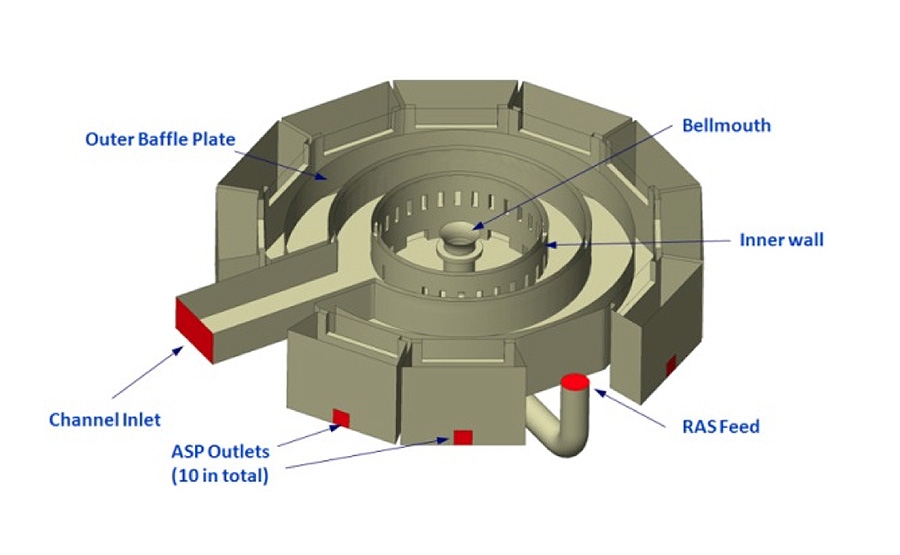
Civil engineering structures are used to distribute the flow and solid loads to multiple settling tanks or activated sludge plant (ASP) lanes at a sewage treatment works (STW). Achieving a good solids distribution requires adequate mixing to homogenise the solids, but this can be detrimental to achieving a good flow distribution, which normally requires quiescent conditions.

Analysis and Design for Final Clarifiers in England

2026-04-02T16:32:44-06:00May 8th, 2016|Tags: , , , , , , |

The Budds Farm Wastewater Treatment Works operated by Southern Water Services Ltd. treats waste water from the Portsmouth and Havant catchments. Prior to 2006, the Wastewater Treatment Works at Budds Farm had eight final clarifiers of 35m internal diameter. In order to meet the requirement of projected AMP4 flows, the existing settlement tanks were modified and two new 35m diameter clarifiers were built to operate alongside the existing eight tanks.

Vapor Intrusion Assessment Near a Residential Development in United Kingdom

2026-04-02T15:02:13-06:00February 24th, 2016|Tags: , , , , , , |

In 1993, as a result of corporate safety, health and environmental policies, the client initiated a review to assess potential hazards to human health and the environment resulting from historical industrial waste disposal activities.

Guidance Manual for Anaerobic Bioremediation of Chlorinated Solvents in Groundwater in Denmark

2026-04-02T15:02:29-06:00February 23rd, 2016|Tags: , , , , , , |

Groundwater supplies at many locations throughout Denmark have been impacted by chlorinated solvents including tetrachloroethene (PCE), trichloroethene (TCE), and 1,1,1-trichloroethane (1,1,1-TCA). Much of the contamination has occurred due to releases from dry cleaning facilities, and solvent plumes are often found in residential neighborhoods. As a result, private and public stakeholders in Denmark are focusing increasingly on cost-effective remediation technologies.

Biostimulation and Bioaugmentation for Passive In Situ Remediation of Chlorinated Solvents in Denmark

2026-04-02T15:12:12-06:00February 23rd, 2016|Tags: , , , , , , |

Groundwater beneath a former manufacturing facility in a small Danish town is contaminated with part-per-million levels of trichloroethene (TCE) and cis-1,2-dichloroethene (cDCE). The TCE and cDCE contamination occurs primarily in a low-permeability clay layer that is not amenable to an active forced-gradient bioremediation design.

In Situ Bioremediation of Trichloroethene and Hexavalent Chromium in Denmark

2026-04-02T15:12:09-06:00February 23rd, 2016|Tags: , , , , , , |

Trichloroethene (TCE) and hexavalent chromium (CrVI) have impacted shallow groundwater beneath an active manufacturing facility in Svendborg, Denmark. The site is primarily underlain by moraine clay deposits, and a thin sand layer is continuous across much of the site.

Go to Top