Geosyntec Consultants Logo

Geotechnical

Pier G Wharf Loading System Upgrade and Pile Driving CQA – Port of Long Beach

2026-06-16T14:30:11-06:00October 27th, 2009|Tags: |

To accommodate for a new, heavier shiploader, the existing Pier G wharf in Port of Long Beach, California had to be upgraded to increase speed and capacity The design called for a moment resisting space frame to be constructed within the existing wharf footprint, yet independent of the existing structure.

Port of Los Angeles Vacuum Consolidation Technology Demonstration

2026-06-16T14:30:12-06:00October 27th, 2009|Tags: |

The Port of Los Angeles sought a field test of vacuum-assisted preconsolidation of hydraulic fill to assess the feasibility of this technology as an alternative or supplement to conventional surcharge techniques for ground improvement of future hydraulic fill sites at the Port.

Herbert Hoover Dike Rehabilitation Reach 1 Seepage Cutoff Wall at Lake Okeechobee, Florida

2026-04-02T14:30:47-06:00October 27th, 2009|Tags: , |

The Herbert Hoover Dike (HHD) rehabilitation project is designed to stabilize and secure the aging dike from potentially damaging severe weather events, and protect the numerous residents and businesses on the southeastern rim of Lake Okeechobee. In 2007, the U.S. Army Corps of Engineers (USACE) placed the HHD on the Top 10 list (at No. 6) of dams in the nation needing repair. The USACE Jacksonville District prioritized rehabilitation of segments that were identified as most vulnerable, focusing initial efforts on achieving the most significant impacts.

The cutoff wall, a critical design feature in the dike rehabilitation, will minimize existing internal erosion, known as "piping," and prevent further damage to the internal structure of the dike. A 22-mile stretch from Port Mayaca south to Belle Glade that is considered the most vulnerable section of the 143-mile dike is the first wall section to be built. The work began in 2008 and is scheduled for completion in 2012. In May 2008 the USACE Jacksonville District selected Bauer Foundation Corp. (BFC) for the first of four (4) major task orders to construct a total of 10 -miles of the planned cutoff wall that runs vertically from the dike crest to a depth of nearly 80 feet in certain locations. BFC selected Geosyntec as part of its team to provide construction quality control/quality assurance services, geotechnical engineering support, environmental protection monitoring, subsurface barrier construction consultation, and provide additional technical resources related to dam and levee rehabilitation.

Water Supply System Geohazard Assessment and Mitigation Engineering for Sonoma County

2026-04-02T15:50:26-06:00October 27th, 2009|

The Sonoma County (California) Water agency is a wholesale purveyor of water to nine public entities in Sonoma and Marin counties serving a total population of 600,000 people. The agency uses its transmission system to divert approximately 62,000 acre-feet per year from the Russian River, its main water source, and has a goal of diverting 75,000 acre-feet per year by 2014. The agency initiated a comprehensive reliability improvement program because they recognized that the water system is located in an area of numerous potential natural hazards such as earthquakes, floods, wildfires, and landslides, and that portions of the system are aging and were not designed to withstand the imposed demands, especially those imposed by earthquakes. The agency selected MMI Engineering, a Geosyntec operating company, to complete a multi-year, multi-hazard reliability assessment and mitigation program for the water supply and transmission system.

Geotechnical Engineering Design for Deep Soil Excavation Program

2026-04-02T15:50:53-06:00October 27th, 2009|Tags: , |

In its effort to expand and renew its campus facilities and related infrastructure, the Los Angeles Unified School District (LAUSD) evaluates numerous candidate sites including properties that may have been impacted by contaminants. All properties being considered for a new school are subject to a rigorous Environmental Assessment and Remedial Investigation process. At one site testing indicated that shallow soils were impacted with lead and deep soils were impacted with petroleum hydrocarbons and volatile organic compounds to such a degree that remediation was required.

Temporary Excavation Design for expansion of Memorial Hermann Heart and Vascular Institute

2026-04-06T13:01:25-06:00October 27th, 2009|Tags: |

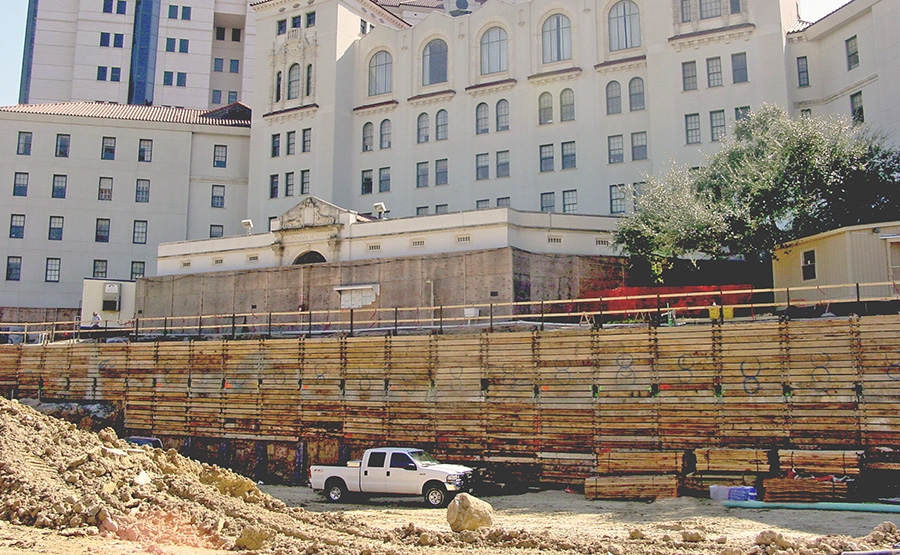
As part of an expansion to the Memorial Hermann Heart and Vascular Institute's (MHHVI) facilities on the Texas Medical Center campus in Houston, Texas, Hayward Baker, Inc. was selected to construct a new below ground parking structure immediately adjacent to an existing structure. The new facility required the excavation of approximately 42,000 sq. ft. to a depth ranging from 18 to 30 ft. below ground surface. Our client, Hayward Baker, was hired by the owner under a design-build approach to provide a temporary excavation support system for this project. Geosyntec was selected by Hayward Baker to prepare and certify the support system design. Our client's goals were to (i) design a system that did not require alteration of the parking facility design or construction methodology and (ii) install the excavation support system without disrupting hospital operations or adjacent utility systems.

Seismic Evaluation and Rehabilitation of the Lake Petit Dam

2026-04-06T11:38:44-06:00October 26th, 2009|Tags: , , |

One of the highest dams in Georgia is a compacted earth structure that serves as a water supply source and supports recreational activities for the Big Canoe residential community in North Georgia. During a routine dam safety inspection by the Georgia Safe Dams Program (GSDP), potentially excessive seepage was reported near the toe of the dam. A resulting detailed evaluation of the existing site conditions led to the development (by others) of a rehabilitation program involving the construction of a large toe buttress to minimize the adverse impacts of the seepage and to provide the requisite calculated factor of safety regarding static and seismic slope stability. The goal of the dam owners (Big Canoe Property Owners Association) was to evaluate alternatives to the toe buttress remedy that could achieve the required factor of safety and be more cost-effective and less environmentally intrusive. Geosyntec was retained by the dam owners to perform an independent third party review of the recommended remedy and assist in the identification of alternatives.

Optimizing the Design Process for Dredged Material Containment Area Dike Raisings Adjacent to Savannah River Harbor

2026-06-16T14:30:21-06:00October 26th, 2009|Tags: , |

The Savannah River Harbor requires periodic dredging to support commercial shipping traffic. These materials are disposed within a series of diked, dredged material containment areas (DMCAs) located on the eastern side of the Savannah River in Jasper County, South Carolina. Under mutual agreement, the US Army Corps of Engineers dredges the materials from the Port and disposes the materials in specific DCMAs identified by the Chatham County (Georgia) Engineers Office. Under this agreement, the Georgia Department of Transportation (GDOT) is responsible for the design and maintenance of the DCMAs which occupy 5,635 acres of land and are bounded by nearly 44 miles of front, back, and divider dikes. Part of this responsibility is to design and stage the requisite dike raisings to provide sufficient dredged materials storage capacity along an 18-mile long reach of the river. At the time of the project, the previous two dike raisings initiated a series of relatively small and localized slope stability failures. Relatively expensive short-term stability measures had to be developed by GDOT to provide the requisite storage capacity. GDOT's primary objective for the project was development of a strategy for optimizing dike construction and DMCA management so that cost-effective long-term dredge material containment could be provided.

Geotechnical Design and Stormwater Management Consulting – Closed Landfill Conversion to Destination Park

2026-04-02T15:50:26-06:00October 24th, 2009|Tags: |

The closed Fresh Kills Landfill site on Staten Island is the largest remaining open space within New York City's five boroughs. The 2,200-acre site, active for more than 50 years, includes four waste disposal mounds ranging in height from 90 to 200 feet and is the final resting place of World Trade Center debris. The City has elected to retain ownership of the site and develop it as a world-class urban recreation destination, creating the Fresh Kills Lifescape Parkland.

Development and Implementation of Comprehensive Dredged Material Management Solutions for an LNG Facility, Savannah, Georgia

2026-04-02T15:50:27-06:00October 24th, 2009|Tags: |

Southern LNG (SLNG), a subsidiary of El Paso Corporation, needed to reopen its liquefied natural gas (LNG) terminal and ship off-loading facility at Elba Island in Savannah Harbor, Georgia.

Go to Top