Brownfields Redevelopment and Vapor Intrusion Mitigation System Design
A former food manufacturing facility sat idle for nearly a decade prior to being redeveloped as a four-story, 2.6-million-square-foot warehouse distribution center.

A former food manufacturing facility sat idle for nearly a decade prior to being redeveloped as a four-story, 2.6-million-square-foot warehouse distribution center.
Historical operations resulted in trichloroethene (TCE) releases to soil and groundwater beneath a large military manufacturing building at the Corpus Christi Army Depot (CCAD), a tenant at the Naval Air Station Corpus Christi in Texas.
Historic releases of dense non-aqueous phase liquids (DNAPLs) at a manufacturing facility in Denver, Colorado resulted in a chlorinated solvent groundwater plume that extended more than two miles below a residential area.
Geosyntec is helping our client respond to various regulatory requests regarding the Aerojet Superfund Site in Rancho Cordova.
Geosyntec provided design support for the Academy Museum of Motion Pictures, the nation's first large-scale museum dedicated entirely to the art, science, craft, business, and history of movies. The museum will be the world's premier institution dedicated to the art and science of movies. With a planned opening in 2019, this Los Angeles Historic-Cultural Monument will house a museum that is simultaneously immersive, experimental, educational, and entertaining. The museum has actively been acquiring three-dimensional motion picture objects and now has approximately 2,500 items, including the only surviving shark mold from the blockbuster film Jaws.
In 1993, as a result of corporate safety, health and environmental policies, the client initiated a review to assess potential hazards to human health and the environment resulting from historical industrial waste disposal activities.
This manufacturing facility in Lomazzo, Italy was originally developed in the 1930s as a factory for manufacturing shoe-making tools, and was enlarged over the next several years. Beginning in the 1960s, operations at the facility consisted primarily of production of thermostats, gas valves, sensors, and timers for a number of applications. Manufacturing activities included shearing and molding of metal coils. Processes at the facility involved the use of cooling/cutting oils and perchloroethylene (PCE) as a degreaser. Manufacturing operations at the facility have since been terminated.
Geosyntec’s client, a large Eastern utility, plans to burn higher sulfur coals in the future, and the fuel change has the potential to increase sulfur trioxide (SO3) and sulfuric acid (H2SO4) concentrations in the flue gas. Besides impacting air emissions, the acid gases could increase equipment corrosion and pluggage in the air preheater (APH) through condensation of sulfuric acid and sulfate salts. Previous test results from a third party stack tester for SO3 and H2SO4 concentrations in the flue gas were inconsistent and appeared to be biased low. To meet their goals and regulatory requirements, the utility retained Geosyntec to assist in the follow-up round of stack testing in determining accurate SO3 and H2SO4 concentrations across the scrubber.
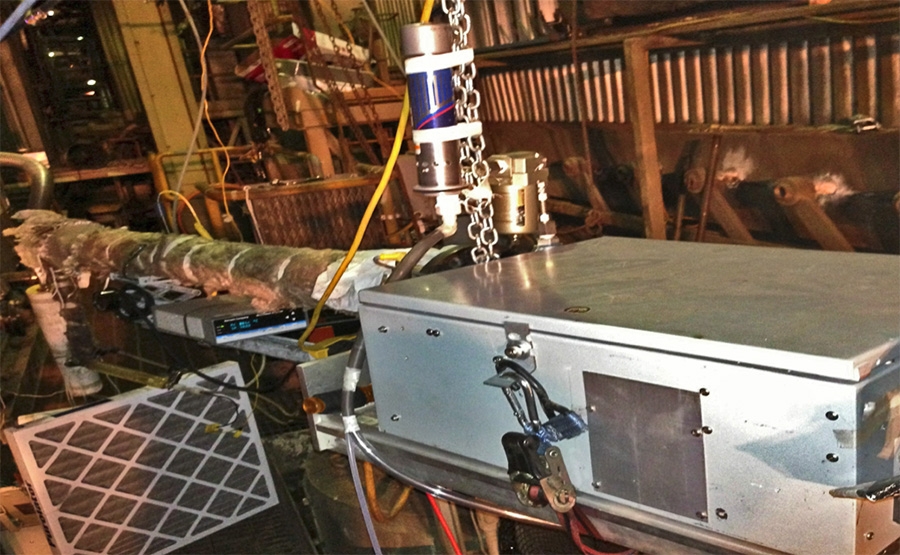
In preparation for compliance with the US EPA Mercury and Air Toxics Standards (MATS), our utility client needed a robust portable mercury analyzer to accurately quantify elemental and oxidized mercury concentrations in flue gas at multiple locations between the selective catalytic reduction (SCR) unit outlet and the stack. The client wanted the ability to monitor flue gas mercury concentration and speciation to understand how it changed during operating conditions.
Geosyntec was asked to devise a measurement method that would accurately determine coal-fired power plant flue gas concentrations of sulfur trioxide (SO3) across an array of exhaust duct locations directly downstream of selective catalytic reduction (SCR) catalyst beds. Besides traversing the SO3 concentrations across the entire exhaust area under the catalysts in a high dust environment, continuous measurements of SO3 at low concentrations (single-digit ppmv) were required in order to gauge the effectiveness of a proprietary SO3 mitigation sorbent being injected into the flue gas upstream of the SCR. These measurements also required a high time resolution (on the order of seconds) in an attempt to assess the variability of concentrations at any given sample traverse point.
© 2026 Geosyntec Consultants, Inc. All Rights Reserved.