Geosyntec Consultants Logo

David Major

Innovative Remedy Application for Groundwater Treatment at Somersworth NPL Site

2026-04-02T15:51:22-06:00October 28th, 2009|Tags: , , , |

The City of Somersworth, New Hampshire, operated a disposal site on a 26-acre property from the mid-1930s until 1981. Originally, the City burned residential, commercial, and industrial wastes at the site. In 1958, the dump was converted to a landfill. While it was in operation, unknown quantities of sludges, solvents, acids, dyes, metals, laboratory or pharmaceutical wastes, and potash were disposed of at the site.
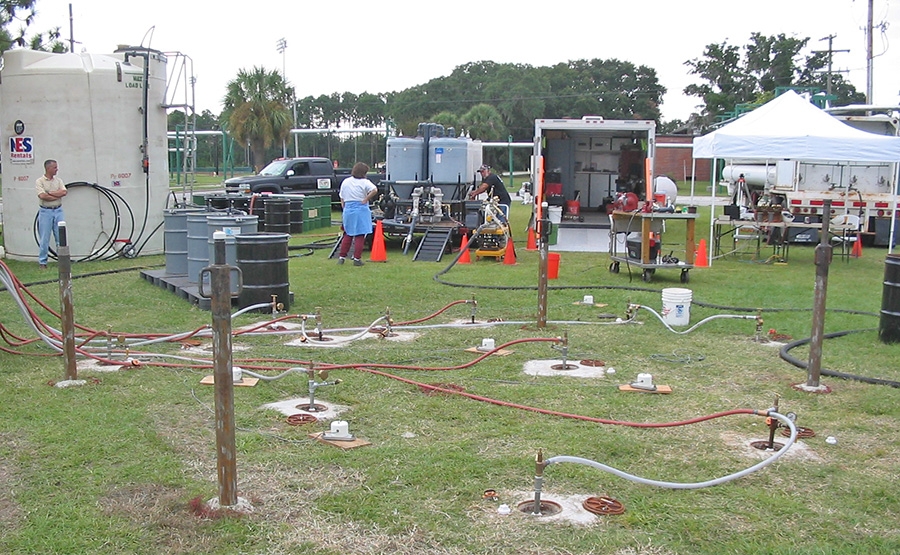
Pilot Test Evaluation of Emulsified Zero-Valent Iron for Chlorinated Solvent Source Zone Remediation at NASA KSC LC 34

2026-04-06T13:20:52-06:00October 27th, 2009|Tags: , , |

NASA's Launch Complex 34 (LC-34) at Cape Canaveral Air Force Station was used for Saturn rocket launches between 1959 and 1968, and is the site of historic releases of trichloroethylene (TCE) used for rocket maintenance activities. It is estimated that up to 88,000 lbs. of TCE are present in the aquifer below LC-34 as a dense, non-aqueous phase liquid (DNAPL), suggesting that restoration of the aquifer through natural remediation processes would take decades. NASA has a strong interest in evaluating and implementing cost effective methods for accelerating in situ remediation of the TCE at this and other site.

Bioremediation of Chlorinated Solvents in Fractured Bedrock at the Caldwell Trucking NPL Site

2026-06-16T14:30:03-06:00October 24th, 2009|Tags: , |

The Caldwell Trucking Site consists of properties and groundwater contaminated by the disposal of residential, commercial, and industrial septic waste. Since 1981, over 300 private wells in the area have been taken out of service due to contamination, and the affected residences have been connected to the municipal drinking water supply system. The area of groundwater contamination is within fractured bedrock, and is contaminated with trichloroethylene and its associated biodegradation products (e.g., cis-1,2-dichloroethene and vinyl chloride) and 1,1,1-trichloroethane. The original Record of Decision stipulated that a groundwater recovery system (pump and treat) be installed at the facility. In February 1997, the U.S. EPA modified the groundwater remedial action schedule, allowing the PRPs to test the effectiveness of a permeable iron reactive barrier to intercept the contaminated groundwater before it discharges at a surface water seep. Monitoring results on the effectiveness of the iron wall indicated the wall reduced the volatile organic compound (VOC) levels in the seep but not to acceptable levels. As a result, additional treatment to reduce the levels of contamination reaching the seep was needed.

Go to Top