Geosyntec Consultants Logo

Canada

Vale CAWMS Upgrades FEL2 Study

2026-05-26T07:06:50-06:00August 20th, 2025|

A copper and nickel mine in Ontario, Canada, plans to expand operations and needed to confirm that their water treatment and maintenance methods would adhere to local and federal standards with the upcoming expansion. The water management infrastructure includes a 62-square-kilometer catchment where operating process water and surface water that was treated in wastewater treatment plants (WWTPs) is held before being discharged into the environment. This central area water management system is susceptible to being overloaded during periods of high precipitation or runoff. Because the mining operation expansion is expected to increase water discharges, the WWTP susceptibility to hydraulic overload could increase, particularly during periods of heavy runoff. The expansions in mining operations are also expected to require additional water storage and treatment.

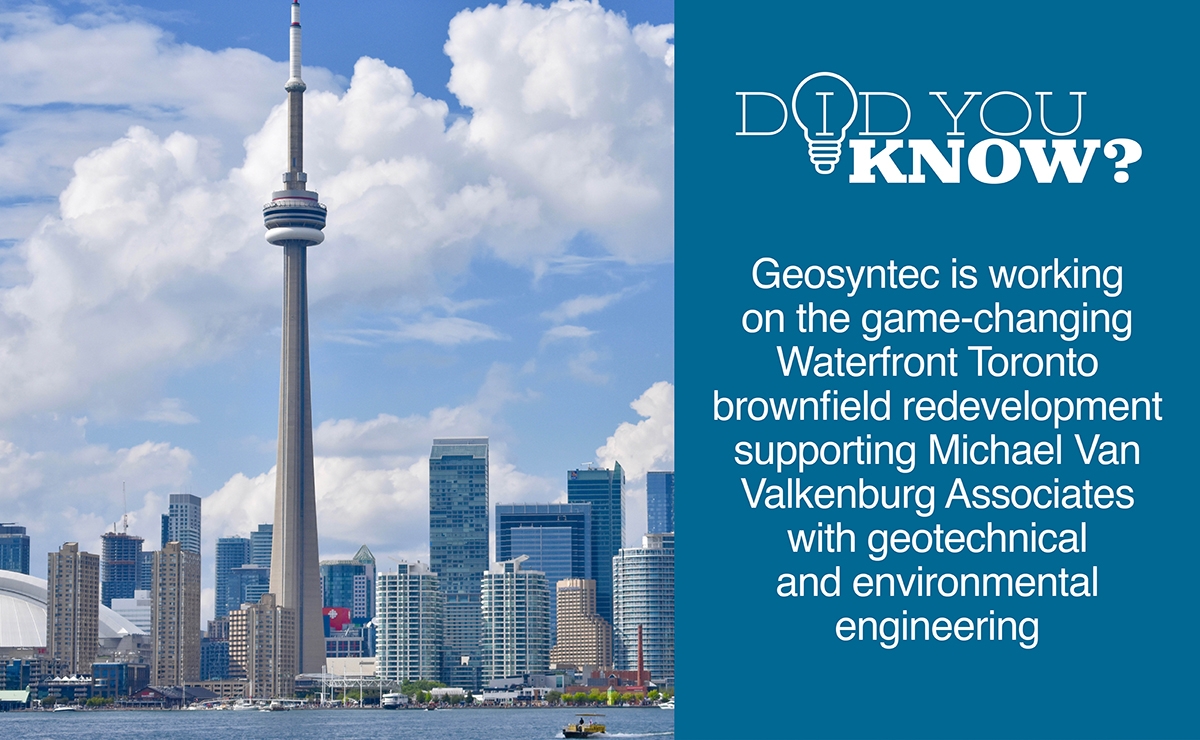
Waterfront Toronto River Channel Risk Management Design and Construction Support

2026-04-02T16:58:32-06:00June 16th, 2021|

A clear example of our capabilities in transforming highly contaminated former industrial waterfront properties into a livable community with improved uses is our experience with the over 700-acre Waterfront Toronto redevelopment project that has a budget of over $1.25 billion.

Estimating PFAS Contamination at Airports in Canada

2026-04-02T16:59:23-06:00October 17th, 2019|

Airports have come under scrutiny over the past several years due to the increasing discovery of a class of chemicals referred to as perfluoroalkyl and polyfluoroalkyl substance (PFAS) in the groundwater beneath and around them. PFAS are key constituents that help make aqueous film-forming foam (AFFF) so effective at fighting fires. Commercial and military airports have required their firefighting personnel to train with AFFF for many years, but these compounds have recently been associated with considerable adverse human health effects, including cancer. In order to get a basic understanding of the true scope of the potential problem, Geosyntec teamed with the Environmental Sciences Group of the Royal Military College of Canada to estimate the number of airports impacted by PFAS in Canada and develop a simple framework for prioritizing remediation needs for these sites.

Wastewater Treatment Assessment of Options

2026-04-07T08:22:33-06:00December 27th, 2018|

The local municipality's wastewater treatment system requires upgrades to achieve long-term compliance with the Province of Manitoba's Nutrient Management Strategy. The municipality presented its preferred option to the local industrial dischargers, including Geosyntec's client. Technical and cost details, including a preliminary framework for cost-sharing between the participating industrial dischargers, were shared and Geosyntec was retained to aid in the evaluation of the municipality's preferred option, and develop on-site upgrade options specifically focused on the removal of nitrogen and phosphorus from the existing anaerobic digestion system effluent for comparison.

Wastewater Treatment Expansion

2026-06-03T13:10:20-06:00July 27th, 2018|

Geosyntec's client required technical support during the wastewater treatment system upgrade design process associated with an expansion of their facility in Portage la Prairie, Manitoba. The client was also required to meet strict new wastewater effluent nutrient limits and disinfection so that wastewater may be discharged to the Assiniboine River.The production expansion increased the overall capacity of the facility by more than two-fold, which required a fast-track wastewater treatment system upgrade design. Upgrades to the treatment system included expansion of the existing pretreatment system: specifically mud removal, oil and grease wastewater treatment and screening, and addition of a biological nutrient removal system downstream of the existing anaerobic digester. The client chose a design-build approach due to the short timeline of the project. Geosyntec provided support to develop a representative design basis, prepare a request for proposal (RFP), evaluate bids received, and evaluate the successful contractor's treatment system design. Several small engineering tasks were also included in Geosyntec's scope, including evaluation of a sanitary lift station. Geosyntec is currently evaluating the final effluent discharge force main. Geosyntec's scope of work included an evaluation of historical wastewater data and data from other client facilities to develop a wastewater design basis for the various wastewater streams from the expanded production facility. The design basis and information on the existing treatment equipment was compiled and summarized in an RFP, which was provided to the design-build bidders. The RFP defined the limits of supply, coordination points, start-up, commissioning and testing requirements, codes and standards, and the client's design standards. The RFP was prepared over the course of three weeks to support the client's fast track project needs. Once bids were received, Geosyntec was a member of the team evaluating the technical merits of the proposed treatment systems against the scope outlined in the RFP and participated in bidder interviews. Upon selection of the successful bidder, Geosyntec continues to review the contractors technical design details and provide feedback and analysis to the client on scope of supply, technical design, and associated costs. Geosyntec also completed engineering evaluations and provided recommendations for a number of smaller scopes of work for the client. Geosyntec evaluated an existing sanitary lift station and developed a series of equipment recommendations to avoid replacement of the lift station wet well and associated yard piping. Geosyntec also continues to support the investigation of the final effluent discharge force main capacity and equipment status. Geosyntec's longstanding relationship with the facility allowed the client to complete the bidding process on a fast track and use Geosyntec's experience with food processing to improve treatment system designs. Geosyntec also identified a number of areas where the contractor's proposed approach to pretreatment would pose long term operational challenges for the facility and supported the development and review of design alternatives.

EMS/Environmental Compliance Auditing and Plant Decommissioning Support to Ford Canada

2026-04-02T16:58:29-06:00October 29th, 2009|Tags: |

The Ford Oakville Assembly Complex (OAC) is one of the first to implement flexible manufacturing and deploy a real-time location system using radio frequency identification (RFID) technology. To manage compliance with Canadian environmental regulations and Ford's internal policies, the OAC had implemented an environmental management system (EMS) based on the ISO 14001 standard. As the company moves forward with plans to improve its environmental performance and realize cost savings, OAC looked to Geosyntec for support in improving its EMS, maintaining environmental compliance, and addressing environmental issues in anticipation of suspension of manufacturing activities as this 5.4 million-square foot complex transitions into the manufacturing center for Ford and Lincoln branded crossover (2007) and hybrid crossover (2010) vehicles.

Go to Top