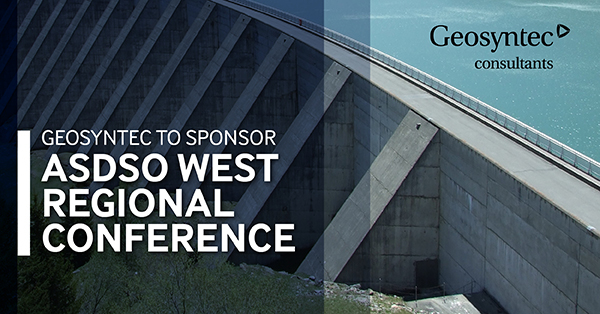
Geosyntec Sponsors ASDSO West Regional Conference
Geosyntec is sponsoring the 2022 Association of State Dam Safety Officials (ASDSO) West Regional Conference. Geosyntec is a Sustaining Member of ASDSO.

Geosyntec is sponsoring the 2022 Association of State Dam Safety Officials (ASDSO) West Regional Conference. Geosyntec is a Sustaining Member of ASDSO.
Clients turn to Geosyntec's nationally recognized geotechnical and geological engineers to develop projects and services that efficiently use geotechnically challenging sites. We apply advanced technologies and leverage our proven practice leadership to provide clients with dependable, cost-effective solutions and customized services while meeting aggressive construction schedules.
When site conditions such as soft and compressible soils, steep slopes, or seismic activity appear to limit site uses, Geosyntec's geotechnical engineering professionals create foundations and other geostructural solutions that optimize site development potential.
Geosyntec has played a leading role in the development of state-of-the-art liquefaction and seismic analyses for over 20 years and has pioneered designing economical structures that safely resist the loads caused by earthquakes or allow for construction over soft soils. Geosyntec is recognized nationally and internationally for our capability to analyze the liquefaction potential of dam embankments and their foundations, as well as to assess the impact of liquefaction on bridges, buildings, and other structures. Our practitioners have performed liquefaction evaluations for hundreds of projects, including assessment of the consequences of liquefaction and development of solutions to mitigate concerns. These solutions have included ground improvement designs followed by testing during construction to verify that design objectives were met. In just one example, a large site owner in Delaware planning to develop a regional waste containment and disposal facility chose Geosyntec to design a foundation and berm on the property that could accommodate challenging subsurface conditions. Our engineers and scientists met the challenge by selecting vertical drains (PVDs) combined with a mechanically stabilized earth (MSE) berm that could be constructed on top of soft, highly compressible river sediments. The 1.5-mile, 60-foot-high MSE berm provided a counterweight at the toe of the containment facility. With almost 2 million cubic yards of material, it is one of the highest and most massive reinforced structures over soft soils built in the United States. Geosyntec's design called of the PVD spacing helped control the rate of pore water pressure dissipation and determined the speed of MSE berm construction and vertical expansion waste placement. To optimize PVD placement, our team developed a project-specific pore pressure dissipation model. As part of the pre-design investigations, Geosyntec developed a sophisticated geotechnical monitoring system consisting of over 150 instruments to track the construction of the MSE berm. The system included electronic piezometers, settlement sensors, shape accelerometer arrays, and inclinometers.
Geosyntec provides nationally recognized expertise and specialized geotechnical and geological engineering (geoengineering) services to evaluate and improve the design and construction engineering properties of soil and rock foundations. Our geoengineering specialists form one of the leading practices in the world. They are recognized for their ability to develop practical guidance, and efficient designs conducive to aggressive construction schedules commonly imposed by project economics. Our geoengineering practice focuses on difficult and challenging sites where the development of dependable, cost-effective foundations, and other geostructural solutions are critical to the success of the project. Our practitioners accomplish this by establishing a thorough understanding of the project site, developing a technical framework for the project, and incorporating the critical, non-engineering drivers such as schedule and project economics into the early stages of our planning. Our geoengineering professionals have responded to the challenges of increasingly unfavorable site conditions by developing and applying sophisticated approaches to investigate and characterize sites; analyzing foundation behavior; altering the engineering characteristics of the soil and rock at a specific site through soil and rock improvement; and environmentally remediating sites. We implement these approaches so foundations and other subsurface structures can be constructed safely, adequately support the built environment, and withstand potential geohazards. Our geotechnical practitioners are fully familiar and experienced with the practical application of these tools. For example, when a client needed to develop a critical structure near Wilmington Harbor in Delaware, the client turned to Geosyntec to geotechnically engineer a practical, cost-effective solution. Our team developed an innovative foundation design and construction methodology for very soft and compressible foundation materials that included wick drains, embankment pre-loading, and mechanically stabilized earthen walls. Our design saved the client nearly $100 million when compared to more traditional approaches proposed by others. Our geoengineering practitioners distinguish themselves by rapid development of an appropriate understanding of the geologic and environmental history of a site, and using this knowledge to screen potential ground improvement and foundation technologies (wick drains, deep soil mixing, deep dynamic compaction, vibro-replacement, and surcharging) to identify the more dependable and cost-effective approaches. These screening-level studies become a basis for gathering optimized geotechnical information based on carefully considered analyses tempered with practical, hands-on experience sufficient to not only characterize the site, but also design dependable foundations. These attributes have been particularly beneficial to our petroleum and chemical industry clients who are currently undertaking large-scale capital projects in undeveloped areas. For example, Geosyntec is working with oil and gas interests on foundation design, offshore reclamation, and underwater slope stability issues related to the development of a liquefied natural gas trans-shipment facility on the coast of southwestern Africa. Our senior practitioners have authored technical design and construction manuals for the Federal Highway Administration focusing on foundation support systems, earth retaining systems, and earthquake engineering. Geosyntec provides lead, geotechnical training instructors for the National Highway Institute and the American Society of Civil Engineers (ASCE). We also provide training to state departments of transportation, contractors, and consultants for state-of-the-practice design applications. Our staff members are active contributors and developers of the American Association of State Highway and Transportation Officials Load and Resistance Factor Design Specifications for bridge substructures including foundations and retaining wall systems. Several of our practitioners have received ASCE's highest awards for advancing the state of the practice in geoengineering.
Geosyntec has played a leading role in the development of state-of-the-art liquefaction and seismic analyses for more than 20 years and has pioneered designing economical structures that safely resist the loads caused by earthquakes. Geosyntec is recognized nationally and internationally for our capability to analyze the liquefaction potential of dam embankments and their foundations, as well as to assess the impact of liquefaction on bridges, buildings, and other structures. Geosyntec has performed liquefaction evaluations for hundreds of projects, including assessment of the consequences of liquefaction and development of solutions to mitigate concerns. These solutions have included ground improvement designs followed by testing during construction to verify that design objectives were met.
© 2026 Geosyntec Consultants, Inc. All Rights Reserved.


