Geosyntec Practitioners to Speak at CASFM
Stephanie Owen, Caleb Hogan, Geoff Uhlemann, Rishab Mahajan, Pardis Hosseini, and James Barbis will present at the Colorado Association of Stormwater and Floodplain Managers (CASFM) 37th Annual Conference.

Stephanie Owen, Caleb Hogan, Geoff Uhlemann, Rishab Mahajan, Pardis Hosseini, and James Barbis will present at the Colorado Association of Stormwater and Floodplain Managers (CASFM) 37th Annual Conference.
Our team leverages its expertise to perform tailored hydrologic and hydraulic studies. Geosyntec develops, calibrates, and uses a variety of hydrologic, hydraulic, hydrodynamic, and other models (1-D, 2-D, 3-D); data analysis; statistical packages; and software tools to conduct analyses related to dam erosion and failure, infrastructure design, flow simulation, sediment transport, temperature and water quality, restoration, and environmental habitat.
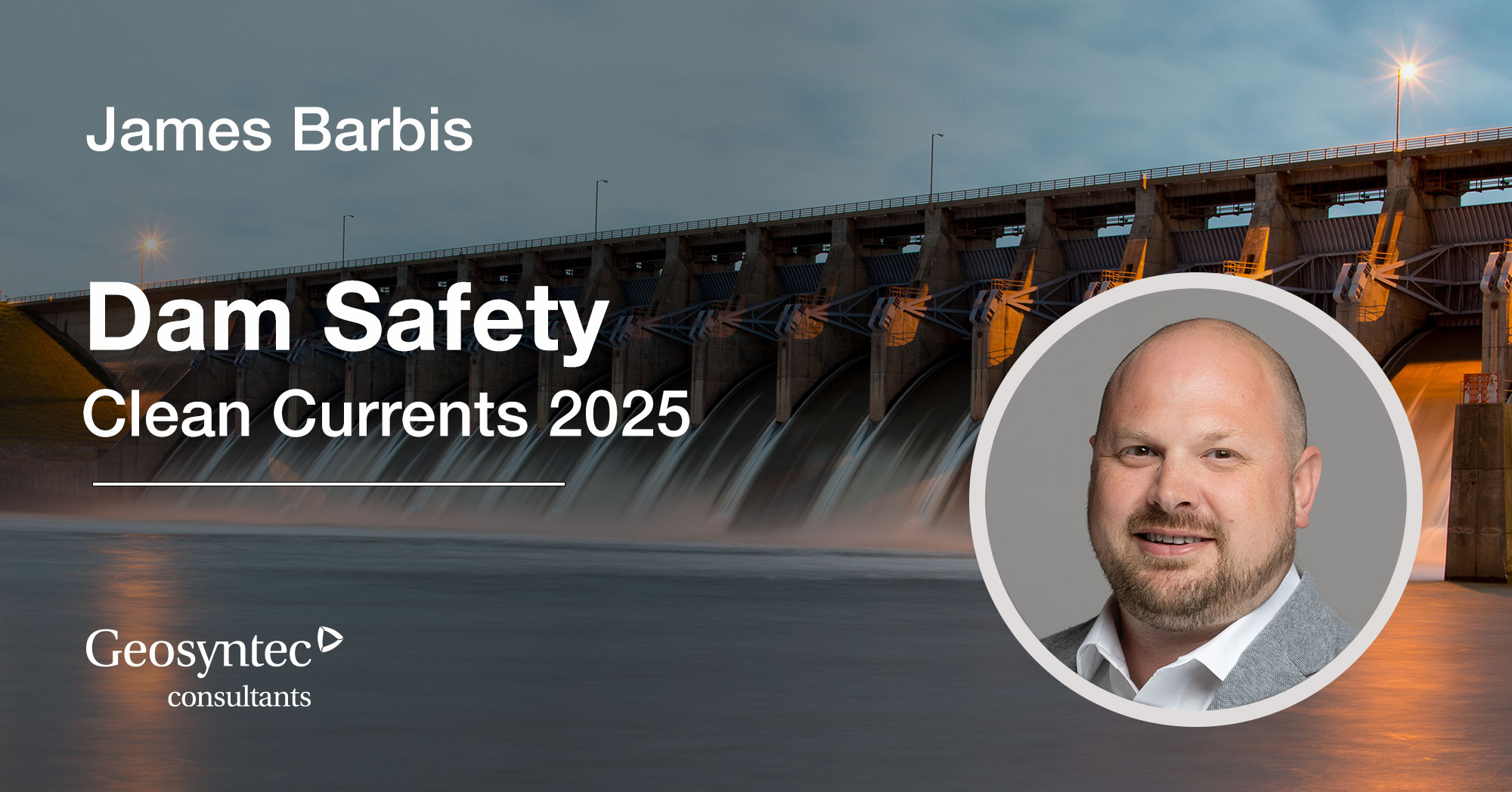
James Barbis, PE, CFM, will serve on the panel, “Dam Safety: Panel Discussions,” at the National Hydropower Association Clean Currents 2025 conference on Thursday, October 16, 2025, at 3:45 p.m. ET in Pittsburgh, Pennsylvania.
James Barbis is a Principal Engineer based in Pennsylvania with more than 15 years of experience focused mitigating flood risks by analyzing, modeling, inspecting, and designing complex hydraulic systems and water-retaining structures.
Geosyntec partners with owners and operators of dams, levees, and flood control facilities to accomplish the following: Assess flood risk hazards and regulatory compliance. Obtain water quality certifications and permits. Evaluate water quality and use impacts on the environment. Develop engineering solutions integrating geotechnical and water resources design requirement. Deliver conservation and restoration projects. Our team leverages its expertise to perform tailored hydrologic and hydraulic studies. Geosyntec develops, calibrates, and uses a variety of hydrologic, hydraulic, hydrodynamic, and other ....
Low impact development (LID) aims to mimic natural hydrology by using small-scale, decentralized techniques that infiltrate, evaporate, and transpire rainwater. The guiding principles of LID are to reduce imperviousness, disconnect imperviousness, conserve natural resources and areas, maintain natural drainage courses, and minimize clearing and grading. Geosyntec practitioners have designed and integrated a number of innovative system architectures to help clients meet each of these goals. Through the use of the latest green infrastructure (GI) and by implementing new sustainable practices, many of our clients have addressed challenges that previously were intractable, unachievable, or not cost effective using conventional passive solutions. We provide specialized stormwater and watershed management services for private facilities, large developers, stormwater utilities, and municipal agencies throughout the United States and have implemented many of the nation's first GI projects. Our stormwater management specialists form one of the leading practices in the country and include individuals whose applied research earned the American Society of Civil Engineers Civil Engineering State-of-the-Art Award and similar accolades at the state and regional level. Our firm's efforts in LID are geared to lower costs for stormwater infrastructure and maintenance, improve surface water quality and groundwater recharge, and design an attractive, ecologically functional landscape. We also have incorporated LID approaches into new development and retrofit projects to improve control of both quantity and quality of stormwater. Geosyntec personnel continuously shape the state of the practice with projects that involve original research, development, and application of LID techniques. Our engineers and scientists are represented on the Board of Directors of the Low Impact Development Center, a nonprofit organization dedicated to the advancing LID technology, and maintain joint research projects with civil engineering faculty at leading academic institutions.
Geosyntec's engineers and scientists stand among the world's foremost experts in urban stormwater management. We are innovators who design best management practices to mitigate impacts to surface water quality, enhance water conservation strategies, and contribute to municipal water supplies. Our professionals develop and implement comprehensive water quality master plans and site-specific designs using green infrastructure concepts for long-term stormwater control. We also guide the development and design of construction, industrial, and municipal programs for National Pollutant Discharge Elimination System (NPDES) regulatory program compliance. We have evaluated the opportunities, constraints, effectiveness, and costs associated with a variety of low impact development and green-streets options and have provided conventional treatment control BMPs for maintaining water quality control. We provide end-to-end solutions for a wide variety of applications from proprietary cistern sizing and optimization modeling and water collection and pre-filtration strategies, to designs for filtration, treatment, and water distribution systems. Our water resources engineers specialize in surface-water and groundwater interactions, ecosystem restoration, multi-beneficial project development, hydromodification management, and erosion and sediment control. In addition, our practitioners have been instrumental in developing, publishing, and supporting numerous stormwater guidance and design manuals. Geosyntec professionals established and continue to contribute to the International Database on Urban Stormwater BMP Design and Performance. We frequently present state-of-the-practice training sessions and workshops on stormwater management, NPDES regulatory program requirements, erosion and sediment control technologies, and BMP performance and design.
© 2026 Geosyntec Consultants, Inc. All Rights Reserved.