
Bioaugmentation to Treat Chlorinated Solvents in Fractured Bedrock
Client
Confidential
Services Provided
Pilot-Test Design; Technical Support; Field Implementation of Bioaugmentation; Performance Monitoring; Conceptual Full Scale Design

Location
Bloomfield, New Jersey, USA
Project Practice Areas
Contaminated Sites
Type of Facility
Maunufacturing Site
Project Specifics
Historic releases of chlorinated solvents at this former electronics manufacturing site led to the presence of elevated concentrations of chlorinated solvents in the subsurface. Geosyntec was retained with the primary remedial goal being to reduce concentrations of chlorinated solvents in the intermediate bedrock zone, approximately 70 to 110 feet below ground surface. The overall objective was to achieve treatment of the contaminated groundwater while minimizing the impact on plans to redevelop the site.
Geosyntec Scope of Services
Geosyntec determined that native microorganisms in the subsurface had the ability to degrade the target compounds, principally trichloroethene (TCE), but in some cases, this native dechlorinating activity was stalling with the production of daughter compounds such as vinyl chloride (VC) and cis-1,2-dichloroethene (cis-DCE). The relatively high concentrations of these compounds indicated that reductive dehalogenation was not resulting in complete dechlorination of TCE to simpler, non-toxic breakdown compounds.
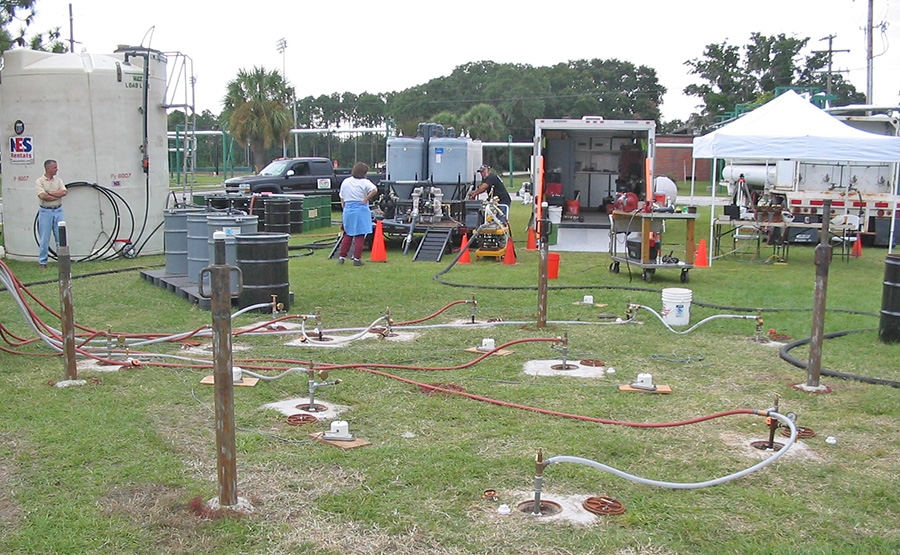
Based on these conditions, bioaugmentation was selected as the remediation technology to be field tested. Emulsified soybean oil with lactate (electron donor) and KB-1, a natural, nonpathogenic microbial consortium containing several strains of Dehalococcoides ethenogenes, were chosen for testing. Two methods of culture and donor addition were performed; passive injection in one area of the site, and injection followed by temporary groundwater pumping (to induce a hydraulic gradient and draw the injected materials through the rock fractures) in another.
Preliminary data and field observations indicated that the passive injection was unable to achieve electron donor and KB-1 delivery to the two observation wells 12 and 24 feet away. The injection with the induced hydraulic gradient, however, was able to distribute the electron donor at least 42 feet from the injection well (to the second observation well). Additionally, microbial analysis one month after injection indicated that the KB-1 culture was present in the extraction well.
After the first two months, data showed that TCE concentrations in groundwater in the vicinity of the passive injection well decreased from over 800 micrograms per liter to less than 100 micrograms per liter. The induced hydraulic gradient injection had similar results, with TCE concentrations dropping from over 120 micrograms per liter to less than 2 micrograms per liter in the injection well, and similar results in the observation wells 30 and 42 feet away. In addition, cis-DCE and VC concentrations were being reduced as the contaminants were completely degraded to ethene and other innocuous compounds. Two years post-injection, there has been no increase in the TCE concentrations, indicating that the combination of the KB-1 culture and a long term donor may be preventing rebound from matrix diffusion.
Notable Accomplishments
In just a matter of months, Geosyntec’s use of Dehalococcoides ethenogenes to bioremediate chlorinated solvents in fractured bedrock has resulted in initial remediation rates of over 98%. In addition, due to the relatively small size of the system required to accomplish this, site redevelopment activities have been able to progress unimpeded, saving significant time and expense for the site owner.
Related Projects
National Aeronautics and Space Administration (NASA)
Cape Canaveral Air Force Station, Florida, USA

Honeywell International
Moundsville, West Virginia, USA

California Resources Corporation, LLC,Moffatt & Nichol Engineers Hearthside Homes, AERA Energy, Occidental Petroleum
Huntington Beach, California

Confidential
Taunton, Massachusetts, USA

Confidential
Camillus, New York


