
As the state navigates a shifting energy landscape that includes dwindling natural gas resources and heightened interest in renewables, communities look for long‑term solutions that strengthen resilience.
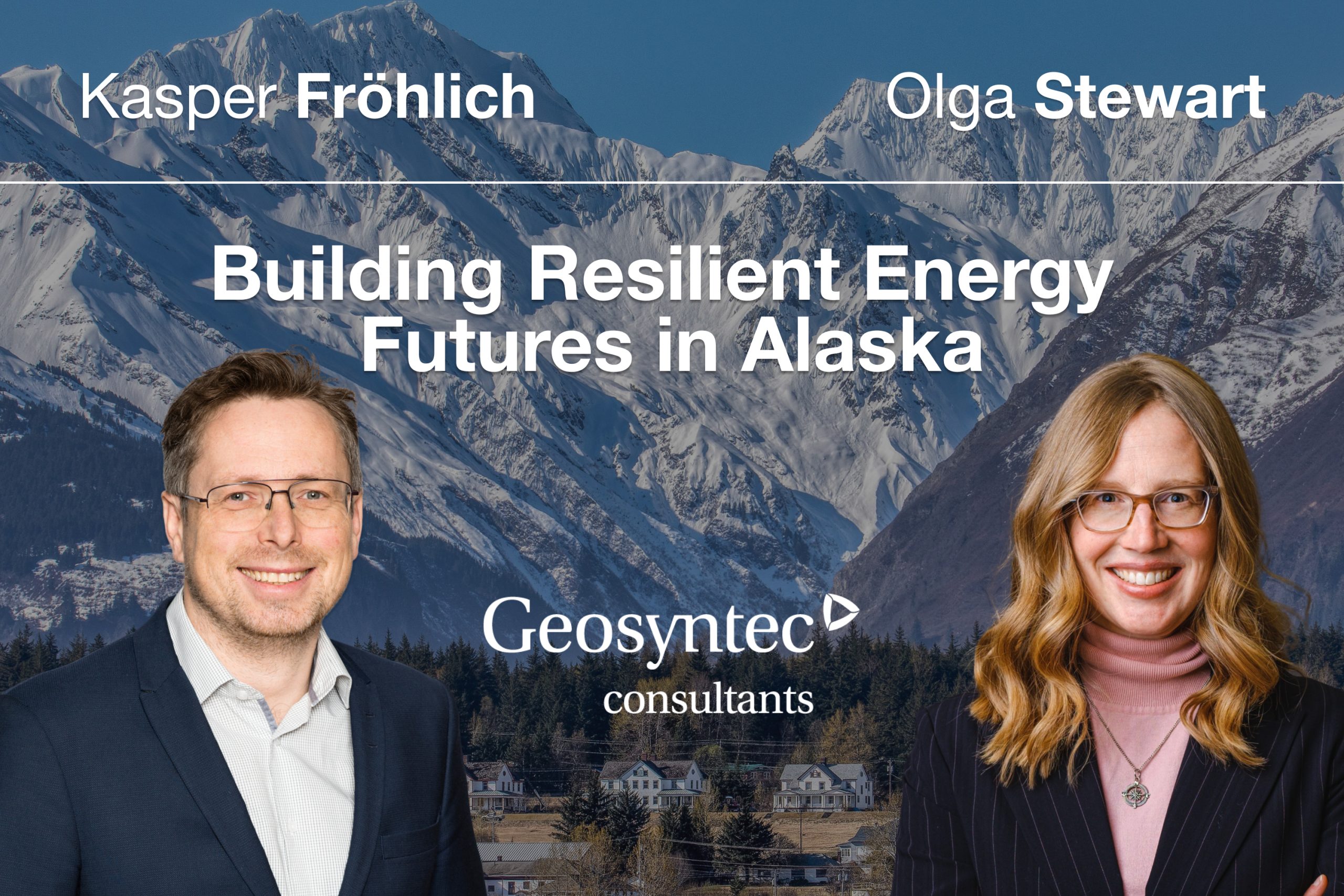
Principal Environmental Engineer Olga Stewart, PE, PMP, and Senior Principal Consultant Kasper Fröhlich know the opportunities and obstacles associated with energy in Alaska. Olga is based in Anchorage and has two decades of environmental and energy experience, while Kasper is based in Texas and brings deep experience working in Denmark and globally to support cold‑climate energy systems.
Olga and Kasper present a grounded yet forward‑looking view of how Geosyntec helps communities transform energy challenges into durable, community‑driven solutions. For both, their commitment to this work began long before energy resilience became a mainstream phrase.
Energy Resilience Support Rooted in Alaskan Experience and Decades of Energy Transition Expertise
“It’s a natural progression for someone who lives here to become interested in energy,” Olga says of her own experience living in Anchorage. The city’s dependence on Cook Inlet natural gas and the uncertainty around its long‑term availability opened her eyes to the fragility of the local energy system.
“I’ve also practiced in the oil and gas sector,” she adds, “and worked on the North Slope early in my career.” When combined with her background in hydrology, geology, and contaminant fate and transport, this puts her in a great position to work toward feasible solutions that fit the realities of Alaska.
Kasper’s path began in Denmark, where energy transition work has been underway for decades. “For me, it’s about taking lessons learned and the things I’ve seen over the last twenty-five years and trying to improve them,” he says.
Having worked across waste‑to‑energy, recycling, hydrogen, ammonia, geothermal, microgrids, and small‑modular nuclear technologies, Kasper offers experience across Europe and North America, which gives him a unique vantage point for thoughtfully adapting solutions from global cold‑climate regions to Alaska’s specific needs.
Place-Based Energy Solutions to Meet Alaskan Realities of Resources, Geography, and Culture
Communities around the world grapple with how to build and maintain reliable and resilient energy systems, especially as energy markets and the global landscape undergo rapid change.
These concerns are particularly visible in Alaska, where the immense land area, scattered populations, and absence of a unified grid, are only some of the complicating factors.
“More than half the state’s population lives in the Anchorage area,” Stewart notes, “but the next-largest cities are smaller and more isolated, and beyond that, there are hundreds of communities that operate independently, many only reachable by air or boat.”
Not surprisingly across this vast landscape, wind availability varies dramatically. Solar can be challenging in Alaska’s high latitudes. Geothermal and natural gas resources depend on local geology. Some areas are too remote to benefit economically from certain technologies. And cultural values, like protecting traditional viewscapes, can influence which solutions are acceptable.
“Up here,” Stewart adds, “energy is place‑based. What works for one Alaskan village might be impossible or undesirable for another.” As a result, energy solutions must be tailored to each community’s geography, resources, and cultural values, with an emphasis on resilience and redundancy.
Alaskan Energy Solutions that Align with Economic Considerations, Local Priorities, and Shared Community Vision
Many Alaskan energy challenges are not purely technological—they are economic and social. Large, centralized systems that work well elsewhere don’t scale down to towns of 100 or 500 people.
“Even promising technologies, like small nuclear, are typically designed for populations far larger than most rural communities,” Kasper says. And while renewable resources exist throughout Alaska, they don’t always align with local priorities or cultural considerations.
“All of this really highlights the importance of aligning around a shared vision,” says Frölich.
“Up here, you can’t afford to think short term,” says Olga. She emphasizes that decisions driven solely by immediate cost savings can overlook the long‑term benefits of reliability and resilience. Infrastructure investments that seem expensive today may be far more economical over decades, especially when factoring in fuel volatility, transportation costs, and maintenance realities in remote climates.
“No one technology or approach is going to define Alaska’s energy future,” Olga says. “Energy resilience is going to come from a mosaic of tailored solutions, smart planning, community collaboration, and long‑term vision.”
How Geosyntec Adds Value to Alaskan Energy Projects
“Geosyntec’s role in Alaska is to act as a connector,” Olga says. “We bridge the gap between communities, technical specialists, funders, regulators, and technology providers. We can help a community imagine a solution for their specific needs, and craft the path to get there efficiently and effectively.”
Olga explains that Geosyntec projects benefit communities in at least five ways:
-
Bringing Global Expertise to Local Problems
With professionals who have worked in cold climates worldwide, Geosyntec helps communities understand what has succeeded elsewhere and how those lessons can be adapted to Alaska’s cultural, climatic, and logistical realities.
-
Supporting Funding and Grant Strategies
Many resilience projects depend on external funding. Geosyntec helps communities identify grants, navigate eligibility, prepare applications, and connect with potential investors and funding partners.
-
Translating Ideas into Actionable Plans
Communities often know what they want, but they need help turning concepts into defined scopes of work. Geosyntec works with residents, utilities, engineers, and investors to shape and clearly communicate goals, and turn those goals into technically viable solutions.
-
Educating Decision‑Makers
From municipal officials to port authorities to tribal organizations, leaders seek out Geosyntec to better understand emerging technologies, long‑term value, and the tradeoffs involved in resilient energy planning.
-
Building Community‑Driven Solutions
Perhaps most importantly, Geosyntec recognizes that every community has its own vision—its own priorities, values, and comfort levels with technology. The firm’s role is to amplify local voices and help shape solutions that fit both the place and the people.
More Information
For more information on power-system challenges and environmental planning in Alaska, contact Olga at OStewart@Geosyntec.com.
For more information on energy transition projects, contact Kasper at KasperF@Geosyntec.com.
