Geosyntec Consultants Logo

United States

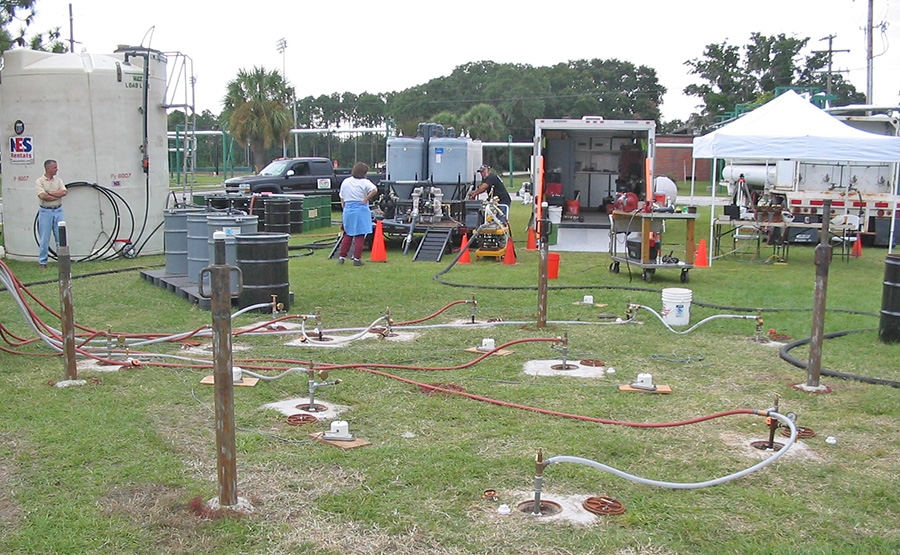
Pilot Test Evaluation of Emulsified Zero-Valent Iron for Chlorinated Solvent Source Zone Remediation at NASA KSC LC 34

2026-04-06T13:20:52-06:00October 27th, 2009|Tags: , , |

NASA's Launch Complex 34 (LC-34) at Cape Canaveral Air Force Station was used for Saturn rocket launches between 1959 and 1968, and is the site of historic releases of trichloroethylene (TCE) used for rocket maintenance activities. It is estimated that up to 88,000 lbs. of TCE are present in the aquifer below LC-34 as a dense, non-aqueous phase liquid (DNAPL), suggesting that restoration of the aquifer through natural remediation processes would take decades. NASA has a strong interest in evaluating and implementing cost effective methods for accelerating in situ remediation of the TCE at this and other site.
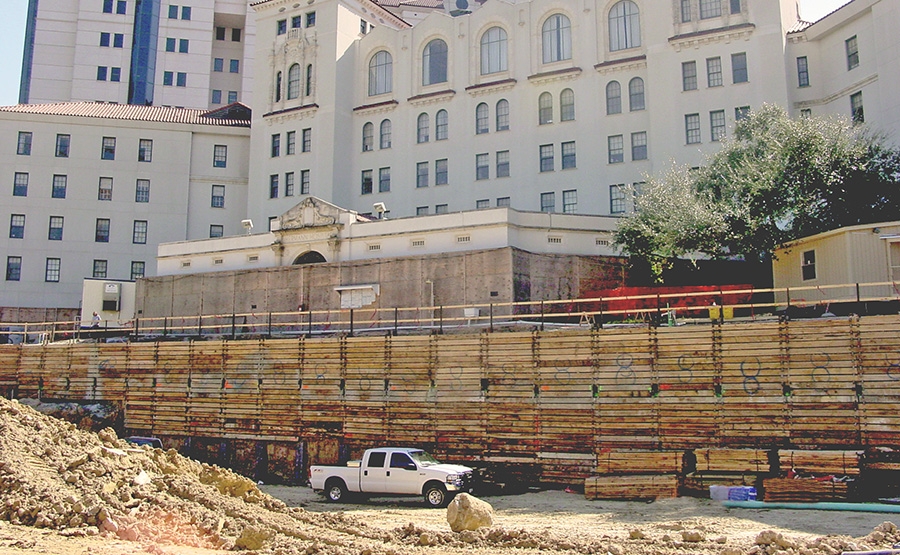
Temporary Excavation Design for expansion of Memorial Hermann Heart and Vascular Institute

2026-04-06T13:01:25-06:00October 27th, 2009|Tags: |

As part of an expansion to the Memorial Hermann Heart and Vascular Institute's (MHHVI) facilities on the Texas Medical Center campus in Houston, Texas, Hayward Baker, Inc. was selected to construct a new below ground parking structure immediately adjacent to an existing structure. The new facility required the excavation of approximately 42,000 sq. ft. to a depth ranging from 18 to 30 ft. below ground surface. Our client, Hayward Baker, was hired by the owner under a design-build approach to provide a temporary excavation support system for this project. Geosyntec was selected by Hayward Baker to prepare and certify the support system design. Our client's goals were to (i) design a system that did not require alteration of the parking facility design or construction methodology and (ii) install the excavation support system without disrupting hospital operations or adjacent utility systems.

El Monte Operable Unit Treatment System and Conveyance Network Design

2026-06-16T14:30:19-06:00October 27th, 2009|Tags: , , |

The San Gabriel Basin has been the subject of environmental investigation since 1979 when groundwater contaminated with volatile organic compounds (VOCs) was first detected. In May 1984, four areas of groundwater contamination within the San Gabriel Valley were listed on the U.S. EPA National Priorities List (NPL).

Seismic Evaluation and Rehabilitation of the Lake Petit Dam

2026-04-06T11:38:44-06:00October 26th, 2009|Tags: , , |

One of the highest dams in Georgia is a compacted earth structure that serves as a water supply source and supports recreational activities for the Big Canoe residential community in North Georgia. During a routine dam safety inspection by the Georgia Safe Dams Program (GSDP), potentially excessive seepage was reported near the toe of the dam. A resulting detailed evaluation of the existing site conditions led to the development (by others) of a rehabilitation program involving the construction of a large toe buttress to minimize the adverse impacts of the seepage and to provide the requisite calculated factor of safety regarding static and seismic slope stability. The goal of the dam owners (Big Canoe Property Owners Association) was to evaluate alternatives to the toe buttress remedy that could achieve the required factor of safety and be more cost-effective and less environmentally intrusive. Geosyntec was retained by the dam owners to perform an independent third party review of the recommended remedy and assist in the identification of alternatives.

Optimizing the Design Process for Dredged Material Containment Area Dike Raisings Adjacent to Savannah River Harbor

2026-06-16T14:30:21-06:00October 26th, 2009|Tags: , |

The Savannah River Harbor requires periodic dredging to support commercial shipping traffic. These materials are disposed within a series of diked, dredged material containment areas (DMCAs) located on the eastern side of the Savannah River in Jasper County, South Carolina. Under mutual agreement, the US Army Corps of Engineers dredges the materials from the Port and disposes the materials in specific DCMAs identified by the Chatham County (Georgia) Engineers Office. Under this agreement, the Georgia Department of Transportation (GDOT) is responsible for the design and maintenance of the DCMAs which occupy 5,635 acres of land and are bounded by nearly 44 miles of front, back, and divider dikes. Part of this responsibility is to design and stage the requisite dike raisings to provide sufficient dredged materials storage capacity along an 18-mile long reach of the river. At the time of the project, the previous two dike raisings initiated a series of relatively small and localized slope stability failures. Relatively expensive short-term stability measures had to be developed by GDOT to provide the requisite storage capacity. GDOT's primary objective for the project was development of a strategy for optimizing dike construction and DMCA management so that cost-effective long-term dredge material containment could be provided.

Bioremediation of Chlorinated Solvents in Fractured Bedrock at the Caldwell Trucking NPL Site

2026-06-16T14:30:03-06:00October 24th, 2009|Tags: , |

The Caldwell Trucking Site consists of properties and groundwater contaminated by the disposal of residential, commercial, and industrial septic waste. Since 1981, over 300 private wells in the area have been taken out of service due to contamination, and the affected residences have been connected to the municipal drinking water supply system. The area of groundwater contamination is within fractured bedrock, and is contaminated with trichloroethylene and its associated biodegradation products (e.g., cis-1,2-dichloroethene and vinyl chloride) and 1,1,1-trichloroethane. The original Record of Decision stipulated that a groundwater recovery system (pump and treat) be installed at the facility. In February 1997, the U.S. EPA modified the groundwater remedial action schedule, allowing the PRPs to test the effectiveness of a permeable iron reactive barrier to intercept the contaminated groundwater before it discharges at a surface water seep. Monitoring results on the effectiveness of the iron wall indicated the wall reduced the volatile organic compound (VOC) levels in the seep but not to acceptable levels. As a result, additional treatment to reduce the levels of contamination reaching the seep was needed.

Evaluation of the Ecological Impact from MTBE on the Seal Beach National Wildlife Refuge at a Naval Weapons Station, Seal Beach, California

2026-04-06T13:05:03-06:00October 24th, 2009|Tags: |

The Seal Beach Naval Weapons Station provides weapons storage, loading, maintenance, assessment, and support to ships and submarines of the U.S. Pacific Fleet. Fully contained within the Station is the Seal Beach National Wildlife Refuge (SBNWR), a 400+ acre wetland and estuary habitat. Site 14 is a former underground storage tank (UST) site at the Naval Weapons Station where leaks and spills led to subsurface contamination by compounds associated with gasoline such as methyl tertiary butyl ether, or MTBE, a fuel oxygenate. Benzene, toluene, ethylbenzene, and xylene (BTEX), which are also components of the gasoline stored at the site, were also detected in the groundwater and creating a potential threat to SBNWR.An existing remediation plan was to use Oxygen Releasing Compounds (ORC) in approximately 180 injection points at Site 14 to clean up the MTBE and BTEX compounds. However, the use of ORC to enhance the microbial degradation of these existing hydrocarbons would have been hampered by the intrinsic high oxygen demand of the site soils, significantly increasing the remediation costs. Before implementing the ORC remediation approach, the Navy requested that Geosyntec complete an ecological risk screening (ERS), field investigation, microcosm study, geochemical evaluation, remedial site evaluation (RSE), and a corrective action plan (CAP) to deal with the contaminants of concern.

Bolsa Chica Wetlands Restoration Design, Huntington Beach, California

2026-04-06T11:35:54-06:00October 24th, 2009|Tags: , , |

The Bolsa Chica site is approximately 1,100 acres of degraded coastal wetland that has been affected by oil field activities for 80 years. After years of controversial development proposals, the site was purchased and set aside for restoration as an off set for construction activities in Los Angeles and Long Beach harbors. The California Coastal Conservancy and other agencies have oversight of the planning and design of the restoration at the Bolsa Chica Wetlands.

In Situ Bioaugmentation for the Remediation of TCE and TCA DNAPL at a Metal Finishing Operation

2026-06-16T14:30:15-06:00October 24th, 2009|Tags: |

The primary manufacturing processes at Crown Risdon's 11.5-acre former Cosmetic Container Division Facility involved metal finishing operations. This resulted in the groundwater becoming contaminated primarily with chlorinated solvents, specifically chlorinated ethenes and ethanes such as 1,1,1-trichloroethane (TCA); trichloroethene (TCE); tetrachloroethene (PCE); cis-1,2-dichloroethene (cis-DCE), 1,1-DCE; and 1,1-dichloroethane (DCA). The two areas of concern are a former lagoon area and the former metal finishing area, each of which has high levels of chlorinated ethenes and ethanes at concentrations in groundwater that suggest the presence of dense non-aqueous phase liquid (DNAPL). Concentrations as high as 65 ppm TCA and 26 ppm TCE have been measured in the groundwater at this facility.

Comprehensive Remediation and Design/Build Services at a Buried Drum Site

2026-06-16T14:30:22-06:00October 24th, 2009|Tags: |

The 6-acre St. Germain Site in Taunton, Massachusetts had formerly been used as a heavy equipment staging and storage area. The former site owner operated a waste hauling business and had buried drums and impacted soils on the property from multiple offsite sources. In 1999, U.S. EPA initiated a Time Critical Removal Action at the site and subsequently excavated over 700 drums from the subsurface. In May 2000, the property owner and a nearby manufacturer were issued an Administrative Order on Consent (AOC) by the U.S. EPA and later a Notice of Responsibility (NOR) by the MassDEP. The corporate successor of that firm retained Geosyntec to perform an initial site investigation at the site in 2000. Geosyntec provided oversight for the AOC and NOR mandated excavation of 4,000 buried drums and 12,000 cubic yards of soil. During these activities, a complex mix of contaminants was identified, including petroleum hydrocarbons, chlorinated ethenes and benzenes, a number of other volatile and semi-volatile organic compounds, and proprietary chemicals.

Go to Top