Geosyntec Consultants Logo

Texas

Ammonia Facility and Subsea Hydrogen Pipeline Development

2026-04-02T16:31:16-06:00September 26th, 2025|

Gulf Coast Ammonia (GCA) is an agricultural and specialty chemical manufacturing facility that has been in development since 2017. With the addition of its new greenfield anhydrous ammonia production facility on the Texas Gulf Coast, which will produce approximately 1.3 million tons of ammonia per year from hydrogen, it will become one of the largest ammonia producers. Air Products, GCA’s engineering, procurement, and construction (EPC) company and operator, is responsible for the development of the subsea hydrogen feedstock pipeline and the diffuser pipeline into the bay.

e-Fuels Feasibility Study

2026-04-02T16:31:15-06:00September 26th, 2025|

TES (Tree Energy Solutions) commissioned Geosyntec to provide front-end environmental studies and permitting and siting services during the conceptual and planning stages of design for two potential electric natural gas (e-NG) facilities in Texas. Design addressed phased production with a 250-megawatt electrolyzer, then use of a 500-megawatt electrolyzer to produce e-NG for European and Asian markets.

Barge Decommission, Dismantle and Dispose Project

2026-05-26T08:29:43-06:00October 27th, 2020|

The U.S. Army Corps of Engineers (USACE) awarded a $35 million contract to decommission, dismantle, and dispose a nuclear reactor installed on a barge in Texas. A few days after a crane was erected on a single layer of lattice crane mats (and while the crane was stationary) subsidence of approximately 3-1/2” was noted below the west crane mat with no observable subsidence below the east crane mat. The crane was removed and a ground improvement program was implemented including installing dry soil cement mix piers (piers) to improve the bearing capacity. Due to obstructions during drilling, only 75 percent of the piers were installed to the design depth. The project required use of this crane for a period of about one year and its successful deployment was critical.

Rapid Vapor Intrusion Characterization and Treatability Testing at an Active Military Facility

2026-05-26T10:25:28-06:00January 31st, 2020|

Historical operations resulted in trichloroethene (TCE) releases to soil and groundwater beneath a large military manufacturing building at the Corpus Christi Army Depot (CCAD), a tenant at the Naval Air Station Corpus Christi in Texas.

Lower Buttermilk Creek Bank Stabilization Project

2026-04-02T16:31:14-06:00April 9th, 2019|

The City of Austin retained Geosyntec to stabilize approximately 450 linear feet of eroding stream bank along lower Buttermilk Creek to protect a threatened multi-family structure and to rehabilitate and restore riparian habitat along adjacent portions of the stream channel. Urbanization and increased impervious cover in the contributing watershed of the stream has resulted in increased volume and frequency of storm runoff and stream flow, which in turn led to stream erosion. The eroding stream bank undermined an existing storm drain and fence, and was threatening other infrastructure. The project objective was to design and implement engineering solutions to stabilize the existing stream bank, protect threatened infrastructure, restore native vegetation along the creek corridor, and preserve existing aquatic habitat.

Sea Level Rise, Storm Surge Analysis, and Protection Design for Malone Superfund Site in Texas

2026-05-25T14:05:37-06:00September 28th, 2018|

The Malone Services Company Superfund Site is situated in a lowland area along Galveston Bay, Texas bordered by open water of the bay and adjacent wetlands and marshes. Hurricanes have demonstrated the vulnerability of coastal infrastructure to storm surge flooding. Sea level rise has the potential to amplify this flood risk. The Record of Decision (ROD) for this superfund project included solidifying on-site oily wastes and disposing of them into a planned RCRA Subtitle C equivalent cell.

CSM Development and Remedial Design for Contaminated Soils, Sediments, and Groundwater, Greens Bayou, Houston, Texas

2026-04-02T15:50:53-06:00October 27th, 2009|Tags: , , , , |

Starting in the early 1950s and continuing over a period of several decades, arsenicals and organochlorine pesticides, including DDT and Lindane, and production raw materials and intermediates, were released into soil, groundwater, and surface water adjacent to Greens Bayou, a part of the Houston Ship Channel system. These contaminants were transported into Greens Bayou and local tributaries to the bayou via industrial discharges, surface water runoff, and groundwater discharge and upwelling. Geosyntec was retained by counsel to the Port of Houston Authority (PHA) to evaluate remediation strategies and develop remediation cost estimates to mitigate the impacts associated with this contamination loading to Greens Bayou and the tributary waterways, the most significant tributary being a large Harris County Flood Control Channel (HCFCC).

Human Health Risk Assessment and Regulatory Closure at a Site in Irving, Texas

2026-04-02T15:49:53-06:00October 27th, 2009|Tags: |

Chlorinated solvents in soil and groundwater beneath this former manufacturing facility are believed to have originated from a former waste solvent underground storage tank. Soils at the affected property consist of plastic clays overlying approximately 150 feet of competent shale. Limited contaminant migration has occurred through fractures in the clay soils. The client (property tenant) expedited site closure to eliminate financial obligation to property owner.

Temporary Excavation Design for expansion of Memorial Hermann Heart and Vascular Institute

2026-04-06T13:01:25-06:00October 27th, 2009|Tags: |

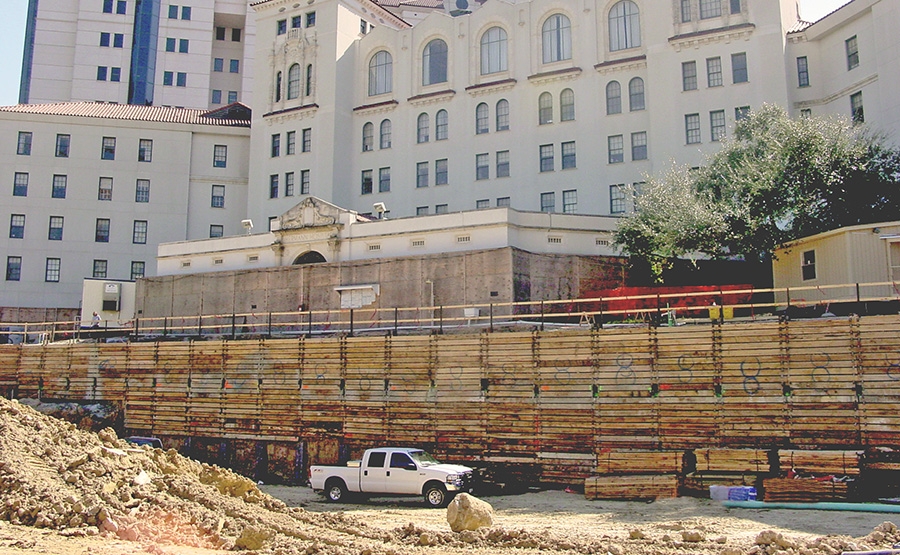
As part of an expansion to the Memorial Hermann Heart and Vascular Institute's (MHHVI) facilities on the Texas Medical Center campus in Houston, Texas, Hayward Baker, Inc. was selected to construct a new below ground parking structure immediately adjacent to an existing structure. The new facility required the excavation of approximately 42,000 sq. ft. to a depth ranging from 18 to 30 ft. below ground surface. Our client, Hayward Baker, was hired by the owner under a design-build approach to provide a temporary excavation support system for this project. Geosyntec was selected by Hayward Baker to prepare and certify the support system design. Our client's goals were to (i) design a system that did not require alteration of the parking facility design or construction methodology and (ii) install the excavation support system without disrupting hospital operations or adjacent utility systems.

Contaminated Waste and Sediment Remediation at Bailey Superfund Site

2026-04-02T15:50:26-06:00October 24th, 2009|Tags: |

Originally part of a tidal marsh between a lake and river near the Texas/Louisiana border, the Bailey Superfund site is an "orphan site" resulting from past waste disposal operations. In the 1950s, two ponds were constructed as part of a fishing camp by dredging the marsh and using the sediments to form dikes. Additionally, a variety of wastes including industrial waste, refinery waste, tarry sludge, municipal waste, and debris were used as fill material for two of the dikes.

Go to Top