Geosyntec Consultants Logo

Tennessee

Center Hill Dam Data Management and Visualization

2026-05-26T08:54:59-06:00November 16th, 2017|

Geosyntec acted as the Data Manager of Record for this barrier wall installation. We developed GIS tools to sync with equipment built by the Conractor (Bauer) to measure excavation shape and visualize these in various views.The Center Hill Dam is located on Center Hill Lake near Smithville, Tennessee. Due to ongoing seepage problems in the foundation, Center Hill Dam has become a United States Army Corps of Engineers (USACE) priority.

Coal Combustion Residuals Management Plans – Kingston Fossil Plant

2026-04-02T15:28:28-06:00July 24th, 2015|Tags: |

Geosyntec has had a strong and continuous involvement in engineering projects at TVA Kingston since the 2008 geotechnical failure. Our involvement includes the following and serves as a demonstration of our experience with coal combustion residuals (CCR) management, disposal, and associated activities.

Emergency Action Plan Flood Inundation Project for the Tennessee Valley Authority (TVA)

2026-04-02T15:28:35-06:00July 24th, 2015|Tags: |

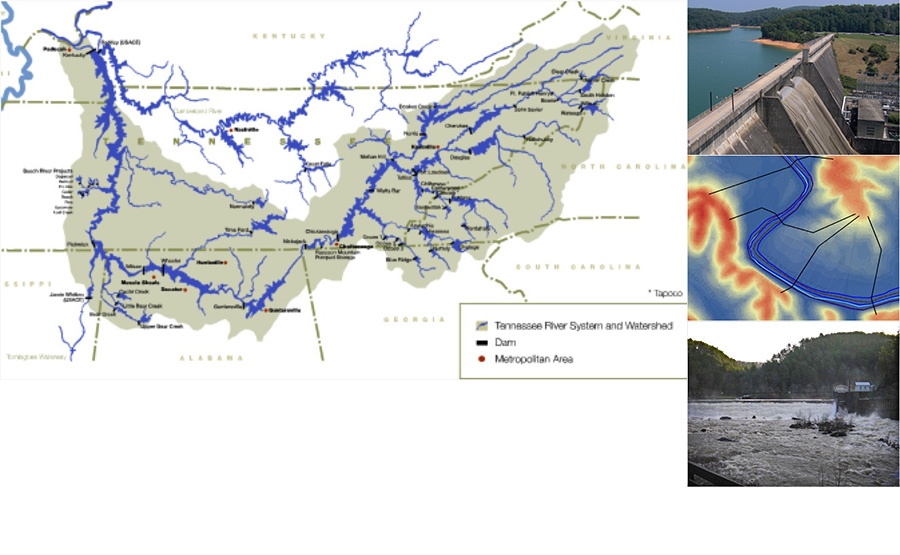
Tennessee Valley Authority (TVA) River Operations regulates a system of 49 reservoirs spanning seven states and maintains Emergency Action Plans (EAPs) for dams throughout the Tennessee River system. The current floodplain maps are based on older models, assumptions, and floodplain mapping techniques from the 1980s. TVA is updating the flood mapping component of their EAPs through simulation of probable maximum floods (PMFs) and postulated failure of 10 main-stem reservoirs and 28 tributary reservoirs. Information describing the hydrology and hydraulics of the Tennessee River watershed was integrated into the current hydrodynamic model.

Bioremediation in Overburden and Bedrock to Address Chlorinated Solvents

2026-04-02T15:50:27-06:00October 27th, 2009|Tags: , |

An accidental release of TCE decades ago contaminated overburden and bedrock at this manufacturing plant. Remediation did not occur until contamination was discovered during an investigation performed as part of a property transaction. Upon this discovery, a pump and treat system was installed by another firm in the suspected source area. This system operated for about a decade, and removed approximately one pint of TCE annually with reported O&M costs of $80,000 per year. Despite groundwater pumping, TCE migrated into the bedrock, moved downgradient and then off-site. TCE and its daughter products eventually began discharging into a stream located on a neighboring property. These seeps have impacted water quality in the stream and threatened to impact water quality in the lake into which the stream discharges. Geosyntec was asked by the client to assist the incumbent consultant in implementing bioremediation in the source area and install a barrier (biobarrier) in bedrock at the property boundary to prevent off-site migration of VOCs.

Karst Hydrology Investigation and Site Preparation for Redevelopment at a Former Metalworking and Foundry Operation

2026-04-02T15:51:21-06:00October 24th, 2009|Tags: |

Metalworking and foundry operations have been the principal activities conducted on-site from at least 1917 until 2005. Groundwater investigations have shown that groundwater on-site and immediately off-site is contaminated with chlorinated volatile organic compounds (CVOCs), primarily trichloroethene (TCE), tetrachloroethene (PCE), and 1,1,1-trichloroethane (TCA). Clayey and silty regolith and fractured and karstic dolomite bedrock underlay the site. GPI Interim retained Geosyntec to 1) develop a comprehensive understanding of site conditions that influence the fate and transport of contaminants at the site; 2) establish a basis for evaluating practical management controls and assessing the appropriate final disposition of the site, and 3) prepare the site for sale to a new owner for the purpose of redevelopment.

Combined Co-Solvent Soil Flushing and In Situ Bioremediation at a Former Industrial Waste Disposal Site

2026-04-06T13:22:12-06:00October 23rd, 2009|Tags: , |

This 30-acre site was the former location of a disposal area burn pit where a wide variety of liquid and solid wastes generated from a nearby manufacturing facility were disposed and periodically burned off. A site investigation began in 1984 under an order issued by the Tennessee Department of Environment and Conservation (TDEC). Primary contaminants of concern at the site include halogenated solvents such as trichloroethylene (TCE), 1,1,1-TCA, and Freon 113. The TDEC issued a Record of Decision (ROD) in 1996 that specified multiple remedies, including soil vapor extraction (SVE), focused excavation, and soil flushing for soils in the burn pit area. The monitoring data collected after a SVE system had been in operation for five years suggested asymptotic performance. The client retained Geosyntec to design and implement a soil flushing pilot test for a comprehensive approach integrating the soil flushing remedy with the site's groundwater remediation program.

Go to Top