Geosyntec Consultants Logo

Alaska

Former Sand Bay Naval Station FUDS Remedial Investigation, Civil Works, Archeology Data Collection and Management

2026-05-05T07:37:05-06:00November 21st, 2024|

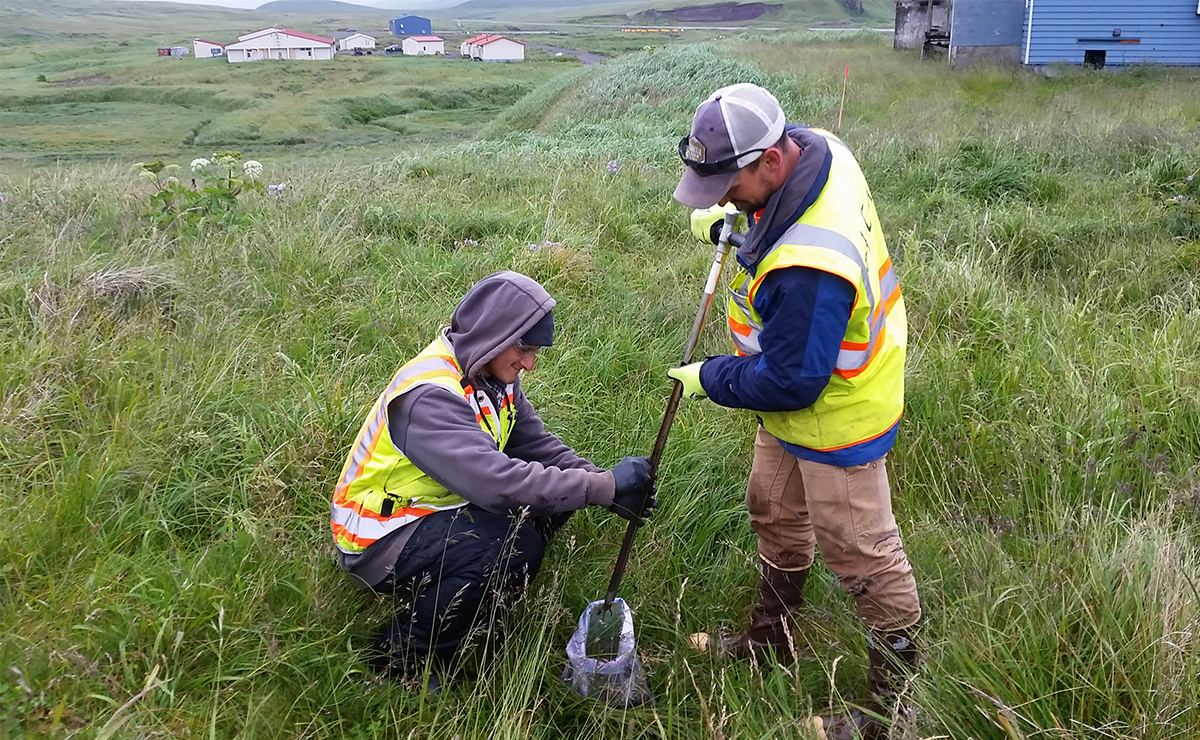
Geosyntec designed and developed a custom mobile app called SitkiNet for a four-year multi-million-dollar remedial investigation (RI) for the former WWII Sand Bay Naval Station Formerly Used Defense Site (FUDS) on the remote and uninhabited Great Sitkin Island in Alaska’s Aleutian Islands. Because the FUDS had limited prior investigation, the RI called for extensive reconnaissance and infrastructure updates, as well as monitoring and surveying of archaeological features. SitkiNet informs and standardizes data collection across a field team of more than 30 people, streamlines data workflows from field collection to reporting for 50+ sites into a standardized USACE data structure, and allows for off-site managers to track progress.

Base Kodiak Remedial Investigation Field Mobile App

2026-05-05T07:39:30-06:00November 21st, 2024|

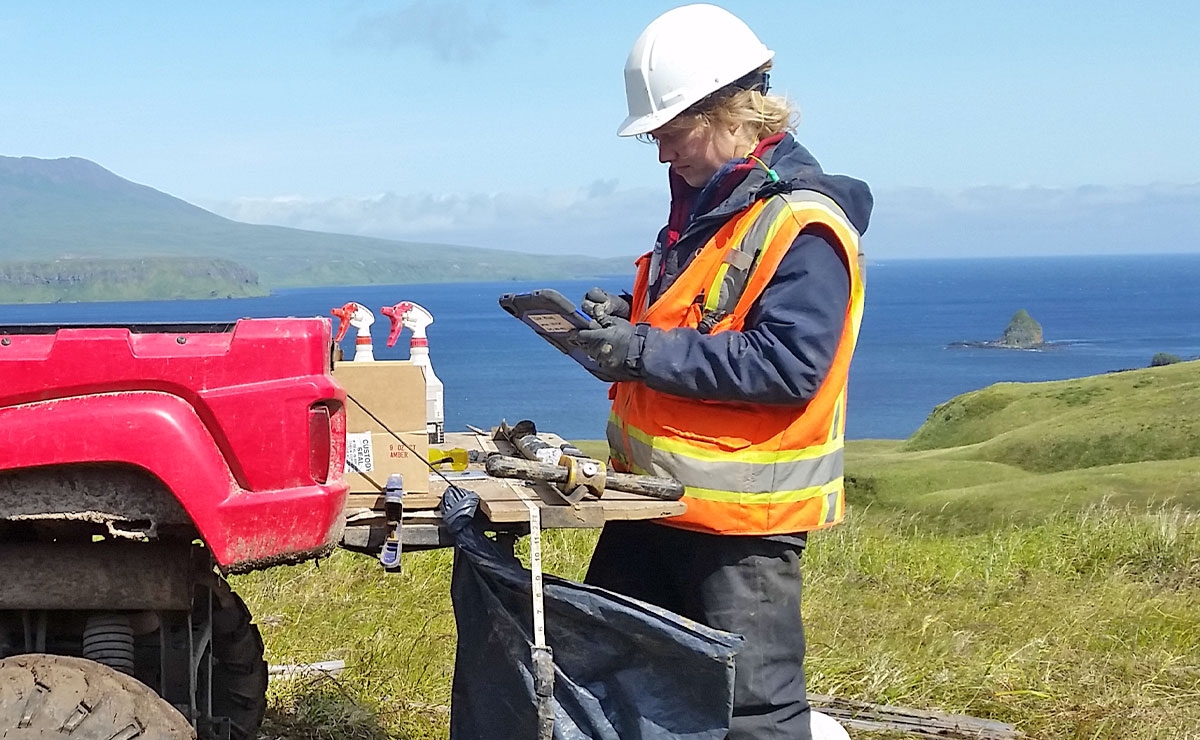
Geosyntec developed and deployed a customized off-the-shelf mobile application (app) using ESRI FieldMaps for ArcGIS to allow the field team to navigate to proposed sampling locations, review historical information contained in the project GIS, survey sampling locations, and display the new locations on a dynamic map.

Historical Geospatial Analysis and Mobile Application Amchitka Air Force Auxiliary Field FUDS

2026-05-05T07:34:13-06:00November 20th, 2024|

The project objective was to review historical documents and imagery and develop a Geographic Information System (GIS) geodatabase to help locate eleven small tanks associated with the Formerly Used Defense Site (FUDS) on Amchitka Island. The Scope of Work was to incorporate layers that overlay maps of the site that identify the historical tank locations as well as other structures, including adjacent piping and buildings. These tanks had been identified during two separate investigations, but inconsistencies in documentation and survey measurements led to uncertainty about the status, existence, and location of each tank. For these reasons, the Alaska Department of Environmental Conservation (ADEC) had been unwilling to grant closure for these potentially contaminated sites.

Emissions Control Technology Training Program for Global Mining Client

2026-04-02T16:01:02-06:00September 21st, 2023|

Geosyntec was engaged by a global mining client to review and improve the operation and maintenance program for the eight diesel engines that generate power for the remote mining site in Northern Alaska. The expansive open-pit mine is powered by eight generators able to provide up to 40 megawatts of electric power for mining equipment, mill operations, worker accommodations, wastewater treatment, and other uses. The diesel engines are equipped with a selective catalytic reduction (SCR) emissions control system that uses urea-injection to control emissions of nitrogen oxides. Following a series of permit violations due to excess nitrogen oxide emissions, Geosyntec was engaged to review and improve the process controls, standard operating procedures, and associated employee training program.

Eielson Air Force Base PFAS Fate and Transport Simulation Model

2026-04-06T11:54:00-06:00January 6th, 2021|

The United States Air Force Civil Engineer Center (AFCEC) required the development of a base-wide groundwater hydrology model to evaluate transport of per- and polyfluoralkyl substances (PFAS) in relation to known groundwater-use receptors at the Eielson Air Force Base (AFB).

Atka Air Force Auxiliary Field FUDS Risk Assessment

2026-04-06T11:55:03-06:00January 5th, 2021|

The Atka Air Force Auxiliary Field Formerly Used Defense Site (FUDS) in Alaska was jointly used by the Army Air Corps and the U.S. Navy from 1942 to 1945. The U.S. Army constructed an airfield that became operational in November 1942. Atka was primarily a U.S. Army installation although the U.S. Navy also performed air operations from there and serviced weather stations and submarine cable systems. By late 1945, the base at Atka was largely abandoned. The Atka FUDS required a remedial investigation (RI).

App-based Data Collection and Management for a Phase II Remedial Investigation

2026-05-26T09:26:10-06:00March 2nd, 2020|

The U.S. Army Corps of Engineers (USACE) conducted a remedial investigation (RI) on Atka Island in the Aleutian Island chain over five years to gather data, fill data gaps, and determine the nature and extent of any hazardous, toxic, or radioactive waste that may remain from military operations on the island during World War II.

Mobile Digital Data Apps for Extreme Alaskan Conditions

2026-04-07T09:45:54-06:00November 5th, 2019|Tags: , , , , , |

Alaska has hundreds of remote contaminated sites accessible only by plane or boat. Investigation and remedial action at these sites take far longer than typical sites because of the short time windows and large funding allocations required to complete incremental steps in the cleanup process.

Geotechnical Engineering and Construction Services at Red Dog Mine

2026-04-07T08:41:47-06:00January 16th, 2019|

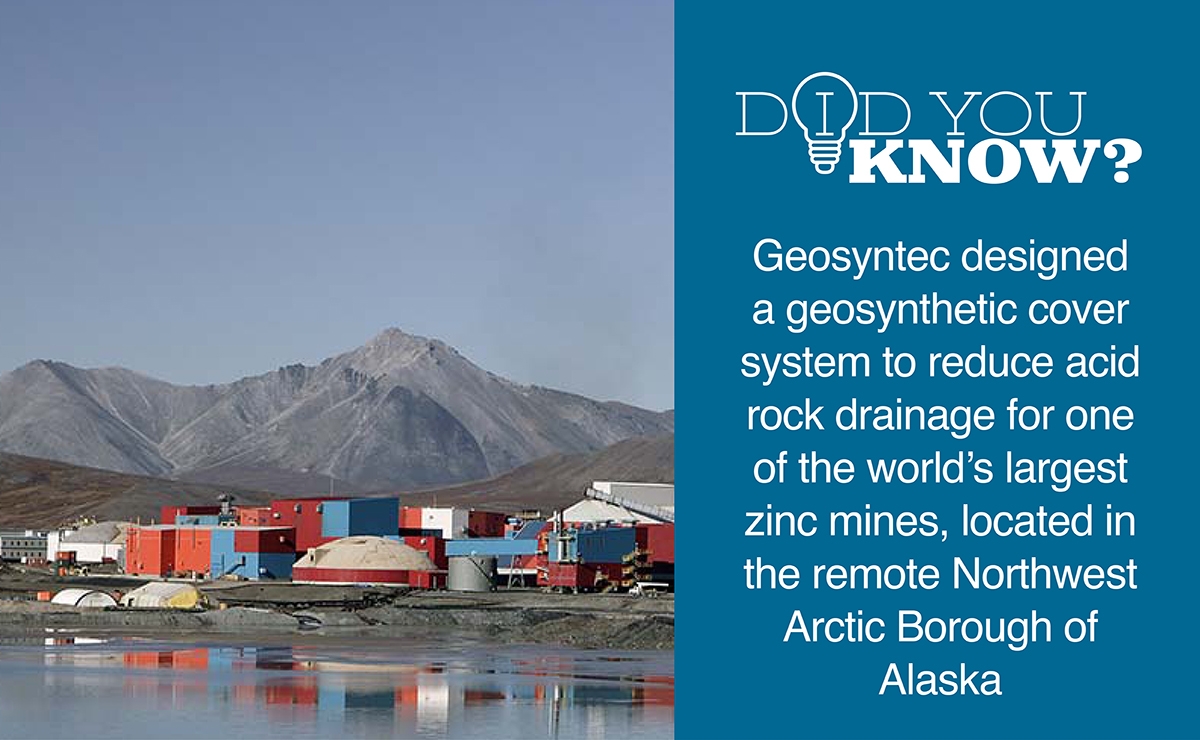
Red Dog Mine is one of the world's largest zinc mines, located in the remote Northwest Arctic Borough of Alaska and operated by Teck Alaska, Inc. (TAK). Mine operations required the stockpiling of waste rock excavated from the first surface mine pit. The natural composition of the waste rock creates acid rock drainage (ARD) that is collected and treated by the mine before being discharged. TAK contracted Geosyntec to prepare a design of a cover system to minimize ARD. Because the mine is in a remote, artic region, the construction season and material delivery timeframe are typically limited to the summer, making design, construction, and oversight services particularly challenging.

Design and Build of Shoreline Sheet Pile Wall for Groundwater Flow Control

2026-04-02T15:35:36-06:00June 1st, 2014|Tags: |

Tesoro Alaska Petroleum Company has an oil refinery in Kenai, Alaska, on a bluff approximately 100-feet above the shores of the Cook Inlet. Historic practices at the site contributed to the presence of refined petroleum products in groundwater migrating toward the shoreline bluff. Tesoro retained Geosyntec to design and build a system to collect impacted groundwater and redirect it to a treatment facility.

Go to Top